





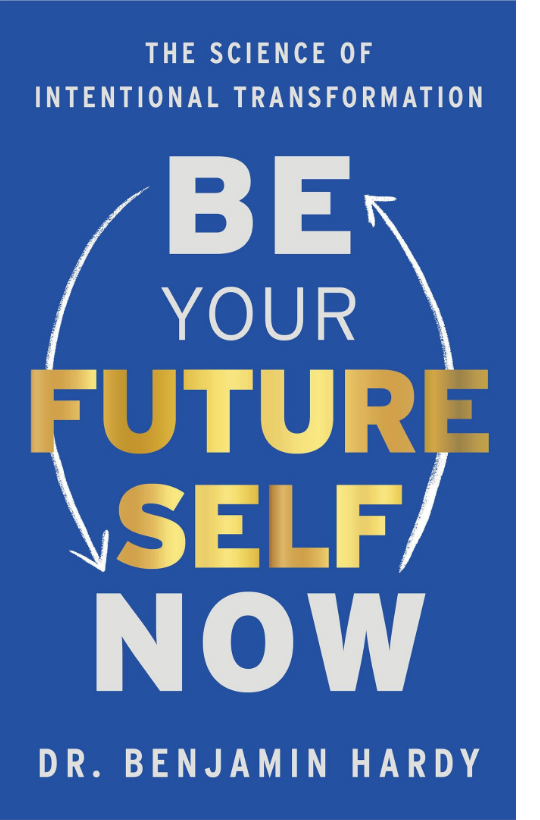

The reason this book matters for business owners is simple. Most of us run the company from the past, and Dr. Hardy makes the case that the past was never actually in charge.
The question I can see people asking is why an organizational psychologist would write about identity for people who just want to grow a company. The answer runs underneath everything he teaches. Owners get stuck because they lead from who they used to be, defending the model that worked and the role that made them money.
The premise of Be Your Future Self Now is a science Dr. Hardy calls prospection: humans are not pushed by their past, they are pulled forward by the future they are most committed to. He builds the entire book on that reversal, and for a founder it is the difference between protecting what got you here and building what comes next.
The core problem the book names is disconnection from your future self, and it shows up as short-term decision-making. Dr. Hardy anchors this in research from UCLA psychologist Dr. Hal Hershfield, whose work he cites throughout: the more connected you are to your future self, the wiser your decisions today.
Most owners are the opposite of connected. They are buried in urgent battles, making myopic calls that costs their future self for years. The fix Dr. Hardy prescribes is to treat your future self as a genuinely different person, someone you owe empathy and good decisions to, the way you would a business partner.
If you skip everything else in the book, do not skip the step Dr. Hardy calls eliminating lesser goals. His framing is the sharpest line in it: we are kept from our goals not by obstacles, but by a clear path to a lesser goal. Lesser goals are the easy, dopamine-friendly wins that feel like progress while crowding out the work that compounds. Dr. Hardy calls them weeds in the garden, and every yes to one is a weed you planted yourself.
This is where the book and our interview lined up most cleanly. We got into the idea that a goal, set correctly, is already halfway reached, because the right goal eliminates the majority of your options before you start. Dr. Hardy credited that principle to venture capitalist John Doerr, then pushed it further: a real scale goal strips out the dead-end paths so you stop fishing ponds that were never going to feed you. A goal is not a target. It is a filter.
The the end-of-history illusion. This is a documented 'bug' in human thinking where you freely admit you have changed a lot in the past, but you assume you are basically finished changing now. You are not. Dr. Hardy argues your future self will be a genuinely different person, with different goals, habits, and ways of seeing the world.
For a business owner, becoming aware of that is freeing, even moreso than I expected. If you know you are going to change anyway, you can stop clinging to your current identity as the finished version. You do not need every answer today, and you are allowed to be in what Dr. Hardy calls the messy middle.
The most common mistake is confusing the epiphany with the work. You read about identity change, feel genuinely different for a week, and mistake the feeling for the transformation. Dr. Hardy has watched this happen at scale. He told me that when 10x Is Easier Than 2x reached hundreds of thousands of readers, his honest estimate was that only about five percent actually went 10x, because most people had the inner shift and never translated it into a tangible goal.
A few specific traps worth watching for:
Dr. Hardy closes Be Your Future Self Now with seven steps for becoming your future self:
If you run a business and you want a place to start, I'd focus on the first two. Clarifying your contextual purpose forces you to name the one thing that actually matters right now instead of everything that could. And eliminating lesser goals is where the real leverage hides, because those easy, dopamine-friendly wins are what quietly crowd out the work that compounds. Get those two right and steps three through seven get a lot easier to act on.
Dr. Hardy's work sits in my top three or four most impactful perspectives on leverage, goals, and how to think about scaling. What sets Be Your Future Self Now apart from the stack on my shelf is that it makes you look in the mirror before it hands you a tactic. The identity shift at the heart of the book, letting your future self drive today's decisions, is exactly what I watch separate the owners who break through from the ones who stall.
When Dr. Hardy and I talked, he put it plainly: it is always better to operate from your future self, the person you want to be, than from your past self and who you have already been. That is the whole book in one sentence. This is the read for the founder who knows they need to think bigger, stop protecting old models, and build a company that does not need them in the center of every decision. If that is the ceiling you are hitting, start here. You can hear the full conversation on the podcast episode, and find more picks on the Business Bookshelf.
Related Podcast Episodes: