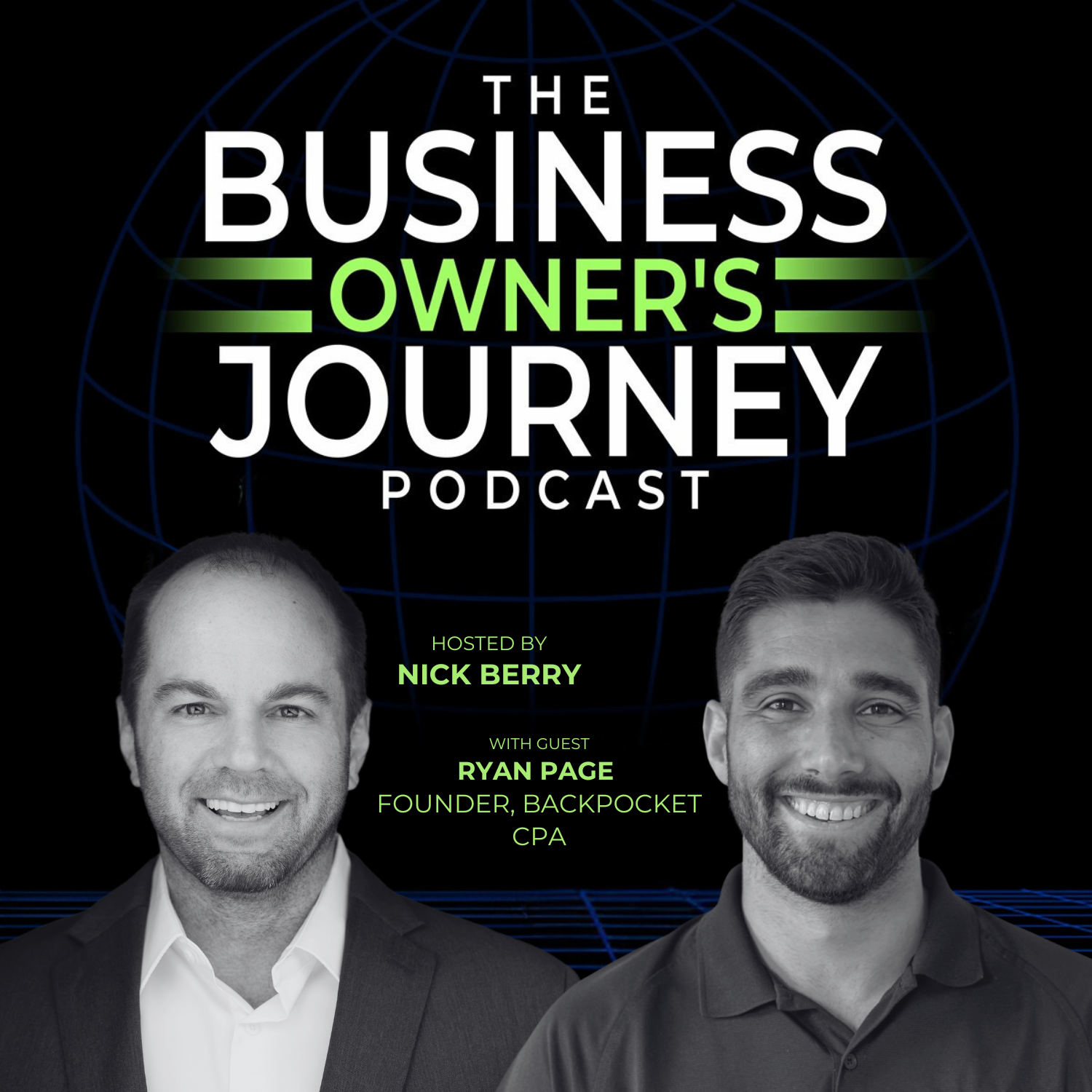


On this episode of The Business Owner's Journey, Ryan Page, CPA and founder of Backpocket CPA, joins host Nick Berry to unpack why agencies need to move beyond gut-feel management and turn financial chaos into confident control.
Ryan explains how his Backpocket Operating System delivers real margin clarity, cash flow forecasting, and actionable profit insights for digital and creative agencies. Nick and Ryan break down the realities of agency finance, the true value of a fractional CFO, the shift from minimal bookkeeping to true financial leadership, and why excuses like "we're not ready" are so costly for growing businesses.
Ryan was also a contributing CPA to Nick's Building Your Finance Strategy Team Guide.
When agencies trade financial guesswork for a systematized approach, everything changes. These lessons offer the mental clarity and strategic confidence business owners crave. Expect actionable frameworks and measured benchmarks that let you operate proactively, not fearfully.
Many owners obsess over revenue, but Ryan highlights why gross margin is the true compass. In Ryan’s words, “the person making a million and keeping $200k is outperforming someone doing $1.5 million who keeps only $50k.”
His benchmark for marketing agencies is roughly 50 to 60 percent gross margin, with net landing between 20 and 40 percent. If those numbers aren't showing up consistently, the service offering itself is suspect. That's the frame every other decision gets measured against.
Bookkeeping is the foundation: weekly updates, clean categorization, and financials anyone on the team can log in and actually read. Ryan treats that as table stakes, the baseline every agency should have running in the background without thinking about it.
A fractional CFO operates a layer above. That looks like forecasting, monthly strategy calls, KPI design, and the kind of partnership where a founder asking "can I afford to hire this person?" gets an answer grounded in cash flow rather than optimism. Ryan's done-for-you model at Backpocket CPA is built to install that financial maturity in stages, so agency owners are making moves backed by real data instead of best guesses.
Ryan has seen the same habit across agency after agency: owners running the business on inbox receipts and mental math, which tends to be a recipe for risky business. His method is to project cash flow over the next 90 days in detail. Even modeling it in a spreadsheet surfaces leaks, mismatches in timing, and the underestimations owners carry around without realizing it.
His free 90-day cash flow forecast is the entry point he hands to founders first. Open the template, enter your cash balance, map inflows and outflows across the weeks ahead, and the distance between your gut estimate and reality shows up. Ryan calls it the fastest way to trade confidence for clarity.
In a $2.5M full-service agency Ryan recently worked with, the owners had department heads for web design, social, and development, but none of them owned the margin of their division. Financial ownership had stayed at the top, which meant the founders were still the only people asking "what's going on here?"
His fix was to tie compensation and incentives to division-level results and upskill the department heads to manage their slice of the business.
That is what unit economics for agencies actually looks like in practice: each service line carries its own P&L logic, each leader is accountable to it, and the owners get out of the weeds. Smaller agencies don't need departmental ownership yet, but they do need the reporting structure that will support it later.
There's always a reason to put off financial discipline, and Ryan calls out "we're not ready" as the number one trap. Delaying the work adds risk and compounds the opportunities slipping by in the background. Nick compares it to wanting to get fit before going to the gym, which is exactly how the avoidance feels from the outside.
Ryan's push to owners is to pull their head out of the sand and start with even a basic audit or a back-of-the-envelope cash forecast. The returns show up almost immediately. As he puts it, "there's no shame in where you are. And let's just start improving it now as we go."
"A lot of people get sucked into the top line… But the person making a million and keeping 200K is doing better than the person making a million and keeping 50K." — Ryan Page
"We're not ready. We're going to look at that next year. And it's just very vague. It's a weird excuse." — Ryan Page
"If you think you're going to outsell ignoring your finances or outsell just bad habits, that's going to be tough... outsell the fundamentals." — Ryan Page
"You need to think about margin, gross margin. Basically, how much money am I making net after servicing this project? And that number needs to be one, sustainable, and two, pretty consistent." — Ryan Page
You’ve built something valuable, but you've hit a wall.
You’re wearing all the hats, attending all of the meetings, making all of the decisions...
You’re not broken. You’re missing a clear picture of what to do next.
The 90-Day Roadmap shows you the path forward:
• Where you stand today in the 5 Stages of Business Growth
• The biggest issues holding you back and your top 3 opportunities to attack right now
• A week-by-week 90-day strategic action plan
It’s free. It takes under 6 minutes. And it delivers the kind of clarity most owners pay thousands for.
NOTE: This is NOT a stock, templated pdf with a few variations. This is a 1 of 1 analysis of your business.
This episode page also appears on
Medium.com.This episode is the subject of
this article on Perplexity.AI.This event is entirely free:
Eventbrite >>If you enjoyed this episode, please subscribe to the podcast on your favorite platform and leave a review. Your feedback helps us bring you more valuable content.
Follow us:
The Business Owner's Journey Podcast host: Nick Berry
Production Company: FCG
00:00 Introduction to Ryan Page and Back Pocket CPAs
01:21 Financial Clarity for Business Owners: A Mindset Shift
04:07 The Financial Operating System Explained
05:35 Why Gross Margin for Agencies Beats Top-Line Revenue
08:40 Integrating Agency Bookkeeping into Operations
12:11 Financial Ownership and Unit Economics for Agencies
14:53 Common Agency Financial Management Pain Points
16:02 Back Pocket Operating System Four-Step Framework
18:50 Cash Flow Forecast and Fractional CFO Impact
23:37 Overcoming "We're Not Ready"
Ryan Page (00:00)
we're not ready. We're going to look at that next year. And it's just very vague. And I don't know if that's just like, I want to keep burying my head in the sand longer or what, or I need to make more money so that I can afford it. Or it's a, it's a weird excuse. Yeah.
Nick Berry (00:12)
like I want to get in shape before I go to the gym.
Ryan Page (00:15)
Exactly,
Nick Berry (00:28)
Ryan Page is the founder of Back Pocket CPAs where he builds finance operating systems to help business owners become better operators. Ryan's also a contributing CPA to my Building Your Finance Strategy Team Guide, which we're giving away in the show notes. Most agency owners are making decisions off of a bank balance and a gut feeling, and we all know that's expensive, and Ryan's going to explain to us exactly why. Expect to learn why gross margin matters more than revenue.
What you should expect from a fractional CFO and what you should expect from a bookkeeper. What a 90 day cashflow forecast reveals that your mental math won't. His take on when to stop DIYing your books. How to build financial ownership into your team. Why accounting should be seen as an investment. What his back pocket operating systems four step framework looks like in the real world in practice. And why we're not ready is the most costly excuse in business.
Enjoy this episode with Ryan Page.
Nick Berry (01:21)
once I got things cleaned up and it looked good and it was easy and it was informative, I feel very different about what the finance is supposed to be doing for me and my responsibilities as the finance leader in my company.
Ryan Page (01:25)
This is…
Interesting.
Yeah.
I think the, what you said there is, or at least what it sounds like is you took responsibility of it. And that's sort of where things changed maybe a little bit. Whereas previously, maybe it was just like a black box, we don't touch. And then also the industry is kind of like boring old accountants, lock them in the room. And so the two of those.
Nick Berry (01:55)
And I didn't know what to expect, what I should expect. guess accidentally I found someone who told me this is what you should be expecting, and this other stuff is what you've just been accepting.
Ryan Page (01:57)
Yeah.
Yeah. So you kind of had someone lead you to the water. Yeah. Yeah. It is nice when have someone who's like wanting to teach you and you're receptive for it. I think that's kind of an important part of finding a good provider too is like, you need to sort of match where you're at with, with, with their
Nick Berry (02:09)
Yeah, I got lucky.
the person that really taught me was still my CPA. and he was just like really, he communicated with me. Well, he understood, like I didn't know what I didn't know, but I was trying to find it. And so he tried to meet me where I was at, but I've always wondered like why it doesn't seem like that is as prevalent as I would have expected it to be like.
Ryan Page (02:29)
Yeah.
Mm-hmm.
Yeah.
Nick Berry (02:45)
because I think, I think that my perspective on that was pretty, was typical common. yeah. So like, what, do you find?
Ryan Page (02:50)
Yeah.
The way that a business owner thinks about their finances and their accounting costs is it's a cost. So it's something that they try to minimize. And when you try to minimize your costs there, you're not going to get the investment side of it because you're paying bottom dollar for it. And so like,
your how can I as a provider invest a lot of time into you or the time that you feel like a CPA should spend on you and you're not willing to pay for it is like the honest truth of it.
Nick Berry (03:22)
So from your perspective, it's like, there are the prospects and clients who are, they're shopping or they're looking for cheap, ⁓ and they're probably not ideal, but then there are the people who are like, I don't mind paying for it. I just don't know where to find it or what I'm actually looking for.
Ryan Page (03:30)
Yeah.
definitely. There's the shoppers and then they don't know what they're looking for. And I think the industry, like a lot of people think like, I just need bookkeeping and bookkeeping is bookkeeping is bookkeeping. then that means that's the thought. And so that means that they try to, again, minimize the cost. But when you like come to someone like us, like we're selling a system.
that works and that we install and like that's how we bubble up the decisions, the ability for you to make decisions. And so it's just a different mindset, I think.
Nick Berry (04:06)
let's talk about the system and kind of in comparison to maybe the perception of bookkeeping or finance as a whole.
Ryan Page (04:07)
Yeah.
the traditional way, is just I just want you to do my books or I just want you to run payroll or, yeah, it's just like one off things. I just want you to do my taxes.
that's like the traditional model, And what we're doing is we're selling a financial operating system for digital marketing agencies. And the way that we see it is like, people kind of follow people being businesses, businesses kind of follow, they all follow a process.
Nick Berry (04:25)
Mm-hmm.
Ryan Page (04:38)
and we pick them up wherever they are on the process. So typically it's, you know, we call it our back pocket operating system and it's a done for you system where we come in and help them become financially mature operators. What that means really is we're coming in, we're auditing the state of the business, putting together a plan of what to do.
And then we're going to clean it up and make it so that you can actually make decisions. And then from there, we're going to create forecasts and, start to drive the decisions more. We're comparing the forecast to the actuals. And so we're, we're in the cockpit with you, like in the trenches, figuring out what the heck to do. And then we're going to, through doing that, we're fortifying the foundation where we're basically making the business stronger. And then as we do that, we, grow, we encounter more.
issues at different stages and then the cycle just kind of repeats finding what's wrong with forecasting it. But it all comes back to creating the financials in a way that helps us bubble up decisions and understand the unit economics of the business so then we can scale on that strategically.
Nick Berry (05:35)
give me some, a few examples if you can of like what type of decisions, what are these conversations that you're able to have then? And compare what I'm thinking about. I put myself in the shoes of somebody who doesn't have that information or hasn't seen that information. So in comparison to what their day is currently like, where it's like, decisions, flip a coin.
Ryan Page (05:48)
Yeah.
Yeah,
the area where I see it the most is you talk to any business owner, we're, comparing notes. Hey, how's business going? top line revenue is X. so everyone talks around top line revenue, but where I think.
people need to focus and where we bring the light first is usually margin. And I think in any business, not just marketing agencies, you need to think about margin, gross margin. Basically, how much money am I making net after servicing this project? And that number needs to be one, sustainable, and two, pretty consistent because otherwise your service offering could fail.
So putting, trying to put numbers to that, say we make a hundred bucks for a marketing agency, 50 to 60 dollars should be what's left after servicing the project. And then the rest of the business should take like, let's say $20 out of that. So then you figure your net margin should be 30 to 40 bucks. 20, let's say 20 to 40 bucks. And so that…
That is what should be true on every dollar that we make through the business. And if it's not, then we need to evaluate our decisions against that framework. And I think that alone is basically, that's the core of the decisions.
that's like marketing industry benchmarks. It's going to depend on the industry. then everything kind of trickles off from there. So in order for us to get 50 % margins, we have to utilize our team in a certain way. And so then we need to start trackling utilization and the way that people are using their time against projects. then,
We get into monthly recurring revenues and churns. And so how do we reduce churns so then we don't have to always get new clients? How do our advertising costs look as a percent of revenue? how's our labor in terms of revenue? So then you're kind of just like benchmarking things in terms of revenue or agency-wise, agency gross income. then, yeah, so metrics all sort of scale, I think, off of the margin and creating the consistency in the business.
Nick Berry (07:49)
so what I like hearing is you've got something to compare to. So we can count, you can count anything, but if you don't know what's good or what's bad, then you just, you've got a number of something.
Ryan Page (07:54)
Mm-hmm.
Yeah.
Yeah. Yeah. And I think a lot of people get sucked. Like I started all of that with was they get sucked into the top line. So they're like, I'm doing great. I'm making a million bucks. But the person making a million in your same business model, the person making a million and keeping 200 K is doing better than the person making a million and keeping 50 K. So it's like a breakdown of fundamentals at that point.
Nick Berry (08:22)
Yeah.
how do you build this into their existing business processes or operating routine? Like, I kind of get how the finance, the department itself would operate, but how do you like build this into their, what they do?
Ryan Page (08:40)
It's going to depend on the size of the business. But say it's like a half a million dollar agency where they're sort of on the smaller end agency wise. But they're cruising along like usually at that level. What I've seen is that they're inconsistent with the way that they don't have any system in place for the way that they're collecting costs associated with their delivering the service.
said differently, like basically the money's not matching right, we earn a dollar here, the expense for it's coming out two months later. So like that all starts to throw off the actual reporting of it. So it's basically we need to condense and align those things. So it's kind of just like that's at that stage, right? We need to get the money coming in consistently where we don't have to think about it. We have to get the money going out consistently and tighten tightening the cash cycle. And then basically
That's the foundation then to get you to the next level. Then at the next level comes down to culture and managing how we're tracking time more. I just did one the other day. It's a two and a half million dollar agency. The strategy there is they already have the team in place, but the team doesn't own any of the financials. So it's basically still, they have no financial ownership as an org.
But then I think because they already have the team in place, we make the team responsible for their specific aspect of the business. so again, the strategy is kind of shifting as the company is a different size.
Nick Berry (10:01)
Tell me more about specifically what you mean when you say they don't have ownership of it, of the numbers.
Ryan Page (10:06)
So there's no one in there that's actually looking at how the business is performing. The owner and his partner are going into QuickBooks, but their financials don't make sense. They're not consolidated enough. I'll say they make sense in the sense that they're updated. They're consistently updated, but they are not designed in a way to drive any decisions. Said differently, when you look at a P &L and it's a P &L profit and loss, when you look at it and it's…
20 different categories of like, okay, we spent this on parking and this on like dues and subscriptions and it's like 10 bucks. Like no one cares about that. So basically you need to condense all of that into the main drivers, main drivers, advertising and marketing, labor and benefits, general and admin, travel and entertainment, and maybe like software. I've had some agencies that get sucked into software. So then those five drivers as a percentage of agency gross income are,
what we start to keep a pulse on.
Nick Berry (11:00)
Okay. And so when you were talking about ownership, what you're saying is like, they're making sure that all the beans are counted, but there's nobody that's making sure that there's insight derived from the numbers.
Ryan Page (11:09)
No, yeah,
no insight there. And then, yeah, in that example, it was, it was considered a full service agency where they have a web design team. have a social media team and they have a head, a development team. Like they have a head of each one, but none of them are responsible for the specific margins of their division. So that's where I mean, like this person's the head of the head of that department.
they should be the one driving the results. And then it kind of gets the owners out of the ones that are like, what's going on here? It's like, actually we'll tie compensation and incentive to the division results and then make the people responsible and upskill them in managing their aspect of the business.
Nick Berry (11:51)
Okay, there you go. So we're talking ownership in terms of authority and ability to affect the numbers, not just making sure that they've been counted correctly.
Ryan Page (11:59)
Yeah,
in that case, was the that was the strategy that I suggested. But I wouldn't say that a small agency where the team. I mean, it's all dependent, I guess, on what they're doing and what they're moving towards.
Nick Berry (12:11)
So give me an example of a smaller agency where it would be different, where you might suggest something different.
Ryan Page (12:16)
half a million dollar agency
They don't have the team in place for that. So basically all of that's still executed through the owners, but they're not going to be able to support the cost of having a head of social media, head of web dev. So I think they need to streamline at that point, get the systems in place to be able to scale it to the next level, revenue wise, margin wise, and then take a step back and implement the people that way.
Nick Berry (12:41)
Okay, so they would install something, I guess, of a lighter version that works for them at that size with the capacity that they have, and then they make it to the next stage and then they can upgrade or build onto it.
Ryan Page (12:51)
Yeah.
Yeah,
yeah, I think the fundamental aspect of the structure of the reports and keeping the margins in line and the percent of agency gross income items in line is enough to give them the visibility that they need at that level. But they don't need like departmental ownership.
Nick Berry (13:16)
it's a path that I remember being going down at one time. so it's like, once the light bulb comes on, do you find that they react kind of the way I described me reacting? It's like, shit, this doesn't have to be a drag. this can be a driver, an advantage for us.
Ryan Page (13:31)
Yeah, it is. It's, it's awesome when the light bulb clicks. And when, I just had a client in the last couple of weeks where they're like, I've been harping on margins, harping on margins, design the reports and so that they could see it. And then they're
in the example, they're at like 38 % margin. And so I'm like, well, this needs to be up. And then it begs the question of pricing and costs going into it. And then they took ownership of basically creating their pricing model and adjusting it. And it's like, this is sweet. we're in this now, like you're understanding the fundamentals of your business. And I'm just here to keep the guardrails around you and guide you. So it's it's a lot of fun when that happens.
Nick Berry (14:09)
You're like a proud parent, right?
Ryan Page (14:11)
I am, I am,
especially because they're younger than me.
Nick Berry (14:14)
the things that people are coming to you and talking about, like the pain points is, you know, it's not just the, it's tax time and I've got a shoe box full of receipts, that kind of stuff, right? Like these are people who are wanting to do more with their money. They're not just trying to check the tax ban box.
Ryan Page (14:24)
Yeah, no.
Yeah, I wouldn't even touch a project like that if I got a shoe box. This is the 21st century. That's my response to that now. If anyone makes me print a piece paper and sign it, it's not for me. so one of the common ones is just
Nick Berry (14:36)
I should be ashamed of myself.
I like that.
What are some more modern versions of those pains?
Ryan Page (14:54)
we don't have the ownership there or like my bookkeeper maintains the books, but we don't know what to do with it. So they're kind of like keeping everything organized in that sense, but not making decisions. So they want to take it a step further from that lens. And that's where the fractional CFO side comes in. Some of them are just, our books are a mess. We've never paid attention to it. And we, that's where we start is clean up the books, get everything.
Nick Berry (15:16)
Do they know
that it doesn't have to be that way? that there's cleaning it up, but then there's like beginning to derive insight and leverage it, right? Which is kind of another level above that. Are they aware that there's an advantage to be had there?
Ryan Page (15:24)
Yeah.
Some are, some aren't. I think for the most part, it's kind of why I like agencies. I'm going to say for the most part, they're aware of it because you figure a lot of them are delivering a service where it's like we're running ads, we're analyzing metrics, figuring out like what to do. And so it's the same thing typically on their business on the inside. Like they know that there's stuff there. They know the essence of like churn and that type of stuff. So.
Nick Berry (15:53)
Okay, that makes sense.
Ryan Page (15:54)
just we don't know how to get there. And they don't want to dedicate the time to it themselves.
Yeah, I'd say those are some of the main ones there.
Nick Berry (16:02)
talk about the back pocket operating system and the four step plan that you take people through.
Ryan Page (16:07)
Yeah. So it's like you said, it's a four step framework. It's a done for you system that basically helps create those financially mature operators. And, the first step is go in and find the leaks. So that's an audit basically of the current state of the books and putting together the plan for one, how we're going to fix it to what's our strategy for the company going forward based on the stage they're in. And then.
The second stage after you do that is to go in and fix everything that you identified. Basically install the reporting structure, make sure that the finance, the, can now derive KPIs from the core of the business. And then from there, you get into forecasting it. And that's like really understanding the unit economics, kind of like we talked about a bit, building the forecast out, making sure we, we have the guardrails, the KPIs in place, and then all of that.
is combined to fortify the foundation. And that's basically, that is the guardrails, the SOPs in place, the systems are there. And that's like the foundation then to grow on. And then as they grow, we need more fixing and finding and forecasting, and then it keeps fortifying it more and more as the business grows.
Nick Berry (17:15)
you deliver this in, it can be in several different tiers, right? So all the way from Fractional CFO to down to bookkeeping level.
Ryan Page (17:22)
Yeah,
yeah, it is. So usually the way it is is like find is usually the first step. come in, we come in, we do the audit. That's where everyone starts. And then we kind of like think of ourselves as a doctor. That's us diagnosing what's going on. And then from there, we can prescribe where they land one, based on what they want and two, based on what we see.
as a company, my, belief is that, and the people that I want to be around is people that can derive value from their financials at any point in time. And so because of that, we do weekly bookkeeping and that's so our minimum.
Basically our minimum base tier is weekly bookkeeping. then we, so we're in there, everything's updated. Anyone should be able to log in at any point and make decisions on their financials. CEO support wise, we typically do unlimited communication through that. And then ultimately we record a video every month. That's basically like, here's what's going on in your books. Here's what we see. Here's some maybe opportunity for you.
So that's our base tier. the mid tier, the growth tier is kind of along the lines of a CFO in a more strategic way of here's your forecast, more aligned, like monthly calls. So we're aligned on the CFO lens. And then we get into a scale tier, which is more of us hands on in the business, cashflow forecasting, budgeting for actual P and L forecasting. then
all the reporting and KPIs around that.
Nick Berry (18:46)
Okay, so they can basically outsource an entire department to you.
Ryan Page (18:49)
Exactly, yep.
Nick Berry (18:50)
what does that look like?
typically.
Cause what I'm thinking of is, it's like you went from Nick, you were basically having to look and see if there was this money in a bank account. That was the way you made a decision on, on anything to now, you know, what metrics matter.
Ryan Page (19:01)
Yeah.
Nick Berry (19:08)
whether they're in good standing or bad standing, and you have some means of determining is what we're gonna spend this money on working or not. That's a very different feeling,
Ryan Page (19:21)
Yeah. Yeah. I mean.
Nick Berry (19:22)
You go from feeling
like a dumb ass to feeling like, I actually kind of know what I'm doing here. I know how to do this well.
Ryan Page (19:28)
Yeah, one, one, know how to do it well. And two, I have a partner with me who's like understands the essence of my business. think those, those two, intangibles are some of the things that I noticed the most is people just start coming to me Hey, what should I do here? what's this decision? I need to pay this person. can I do it?
to me I'm like follow the cash forecast but again it's also like a blessing that they trust me to help guide the decision.
Nick Berry (19:50)
Yeah.
It is, and it's a good thing that they found you. the realization that I had, and I think that that's what we're talking about with them prior to meeting you is you look back and you're just carrying around all these different versions of the question. Like, how do I know if, or how do I know when, you all, your all these decisions are all like, how do I know if I should, or how do I know what to.
Ryan Page (20:20)
You
Nick Berry (20:20)
you just don't have the visible, the information on hand or in front of you to be able to make those decisions. So you've got this like tangled ball of.
Ryan Page (20:24)
Yeah.
Nick Berry (20:30)
things that you'd like to be intentional about doing and doing well, that you're just kind of winging it.
Ryan Page (20:32)
Yeah.
Yeah, you're well. There's cash there. I think I'm good.
Nick Berry (20:39)
Right.
And when you think about it like that and how long you like somebody like me was dodging the raindrops, it makes a lot more sense why you hear these statistics about how many businesses go under. Well, hell yeah, they go under if they're making their decisions as uninformed as I was at that point. And I think a lot of them are.
Ryan Page (20:45)
Yeah.
Yeah.
Yeah. Yeah. I mean, it's, chaos and gut decisions and not focusing on the fundamentals. Yeah.
Nick Berry (21:04)
Guessing. Yep, guessing.
But fortunately, to get from there to where you feel like, shit, I've been staggering around blindfolded for a while to feeling like you know what to do and you know how to do it well. there's some learning involved, but
Ryan Page (21:13)
Mm-hmm.
Nick Berry (21:20)
you find somebody like Ryan, who they've done all the acquiring the knowledge they can give you the system and basically figure out how you to stay in your lane, do your thing, but do it being informed by the finance department, the reports, the forecast and all that.
Ryan Page (21:32)
Yeah.
Exactly. Yeah. I think part of what you said there, that's really important is staying in your lane. cause a lot of people, again, it goes back to bookkeeping being a cost. think, I can do this myself. And then either a, they do it wrong or B they do it once a year and it's wrong. And so I think those elements combined are, important there, stay in your lane and like bring on the help to, to guide you.
Nick Berry (22:02)
I'm definitely not an advocate for find the cheapest you can that's too close to guesswork, right? And that's no way to operate.
Ryan Page (22:07)
Yeah.
Yeah, for sure. think a lot of people don't know and wonder like how much should they pay? And I think just an industry benchmark for accounting services is usually like two to 3 % of revenue. And so if like they're if one, if you're not paying that much and getting good service, then kudos and your CPA is under charging. Or if they are then yeah, you're in the you're in the ballpark of kind of what
what is typical.
Nick Berry (22:34)
2-3 % I did not know that but…
I think from the time I met the CPA that I mentioned, who kind of enlightened me, invest heavily in our relationship with them, there's not been any question that it's been worth it every year. we can see the numbers the reason that I say that is because I think
Ryan Page (22:44)
Mm-hmm.
Yeah.
Nick Berry (22:54)
That's what somebody should expect and they should get out of working with somebody like.
Ryan Page (22:56)
Yeah.
Yeah, yeah, I think that's awesome that you feel that way about your provider too. I'd love to meet him because I love having good CPAs in my back pocket.
Nick Berry (23:09)
they're in Louisville. He's in Louisville, but I think their firm main, main branches out of Nashville, they're close to you. like when you're thinking about running your business and you're, you're putting together your team of people.
Ryan Page (23:10)
yeah.
Nick Berry (23:20)
putting together your like board of advisors, the people you need in your year and having your team of professionals that are involved. You your, your finance expert is got to be involved at every level. And if not, that's just a monster blind spot.
Ryan Page (23:31)
Yeah, absolutely.
I agree.
Nick Berry (23:37)
And a dangerous one.
I'd like to know where should they start right now? what is the thing that they're telling themselves that would keep them from actually starting? That's they shouldn't be telling themselves.
Ryan Page (23:47)
That's a funny one, because it's like, I feel like I hear in a few prospects lately that just, we're not ready. We're going to look at that next year. And it's just very vague. And I don't know if that's just like, I want to keep burying my head in the sand longer or what, or I need to make more money so that I can afford it. Or it's a, it's a weird excuse. Yeah.
Nick Berry (24:05)
like I want to get in shape before I go to the gym.
Yeah.
Ryan Page (24:08)
Exactly, exactly.
Nick Berry (24:11)
Okay. Well, that's, I'll leave that to the listener to put them together on that one.
Ryan Page (24:14)
Yeah. Get your head out of the sand and just
go get an audit or something like, or I mean, even, even easier. Where does someone start with basically like I have a template that I can give you, or you could just pull out an Excel document and enter your cash balance as of today, estimate your inflows and your outflows and basically columns along the top of weeks. And then just start.
Nick Berry (24:19)
Yeah.
Ryan Page (24:36)
like you're already keeping a running tally in your head, just start to model that out like two months ahead. And that alone is like a good quick clarity check of like, where's cashflow going? And then what, and then it gets into, okay, well, what do we need to do to stabilize this? Or what do we need to shift or delay to make sure we're not going negative right there? So that's a good, a good low hanging fruit to maybe get past that hurdle too.
Nick Berry (25:00)
is that the 90 day cashflow forecast? Got it.
Ryan Page (25:03)
Yeah.
Nick Berry (25:04)
Yeah. But you got to get started somewhere. I think, no matter what the like, one of the first things that will happen is you'll realize that the tally that you have been running in your head is not as close as what you think. You might already know that. You've probably like cut a little deeper, cut all the way to the bone a few times and realized like your math is bad. ⁓ Yeah. It's risky business.
Ryan Page (25:25)
Yeah, that's, that's very common to,
uh, I just had the conversation yesterday. Someone I've been working with too. That's like, Oh yeah, we, we estimate 500 bucks a month in meals. It's like, eh, you're trending to 2,500, 2000 to 2,500 a month. Like that's a big difference or software. Same thing, like five X what you think. So
Nick Berry (25:48)
Yeah.
Ryan Page (25:48)
Those are common.
Nick Berry (25:50)
Yeah, the software went up.
Ryan Page (25:52)
Yeah, it's fun to try them out and then they just get lost. Or you like, you just put one random thing in there and then you just have to keep it forever. Yeah.
Nick Berry (26:01)
Yeah, they've got their hooks in.
no matter how bad you think it is, you're not going to be the first person to be in that spot. But you got to start fixing it.
Ryan Page (26:07)
Exactly. Yeah. mean, there's no shame in it. Exactly.
No, no shame. think that's something very important to you. Like everything we've talked about here, obviously is there's a lens to look at it of like, shoot, I'm doing that. shoot. I'm doing that. But then the other lens of it is like, it's where you are and like, there's no shame in where you are. And let's just start, start improving it now as we go.
Nick Berry (26:29)
Mm-hmm. Yeah, think, you know, Ryan won't shame anybody. I'll shame.
Ryan Page (26:33)
Yeah, you can. It's a… I won't.
Nick Berry (26:34)
There's no
shame in it. I think for me, there might be a little bit of shame in knowingly continuing to do it, right? At a certain point, you're gonna have to get out of your comfort zone and make the move. ⁓ And I don't know a single person who's ever decided to pull their head up out of the sand and get out of their comfort zone and just
Ryan Page (26:48)
Yeah.
Nick Berry (26:56)
take it on the chin, go through the process, get things fixed. Who said they regret it? They always were like, I should have done this however long.
Ryan Page (27:01)
Yeah.
Mm-hmm.
Yeah, it's such a weight for so many people for so long and like I'm sure you feel you feel like a better operator to just more confident like aware of the numbers even if you still have a black hole like software like you know, it's there and whatever
Nick Berry (27:06)
It is. Sure is.
Yeah.
Yeah. what you just said, I think is another really important aspect. Like anybody, if anybody who's listening to this and, most people who are in business, they want to be a good operator. They want to be a good business owner. And you just, you can't be, you can't really be that if you just disregard, if you think you're going to outsell.
Ryan Page (27:29)
Mm-hmm.
Nick Berry (27:38)
ignoring your finances or outsell just bad habits. Yeah, that's going to be a tough
Ryan Page (27:40)
Mm-hmm.
outsell the fundamentals.
Nick Berry (27:47)
Ryan, appreciate you, man. Thank you.
Ryan Page (27:49)
Yeah, thank you. This was fun.

Nick Berry is an American entrepreneur and business advisor, whose track record includes founding, leading, and advising award winning small businesses since 2002. He has built companies in multiple industries, hosts The Business Owner’s Journey podcast, and created the Business Alignment System™ framework that helps owner-operators scale without burning out.
After his most recent exit he founded Redesigned.Business to advise and coach to other entrepreneurs and business owners who are looking for a trusted (and proven) advisor.
Among peers, colleagues and clients, Nick has been referred to as 'The Anti-Guru', due to his pragmatic approach and principled leadership. He shares his thoughts, experience, and lessons learned each week in The Golden Thread newsletter.