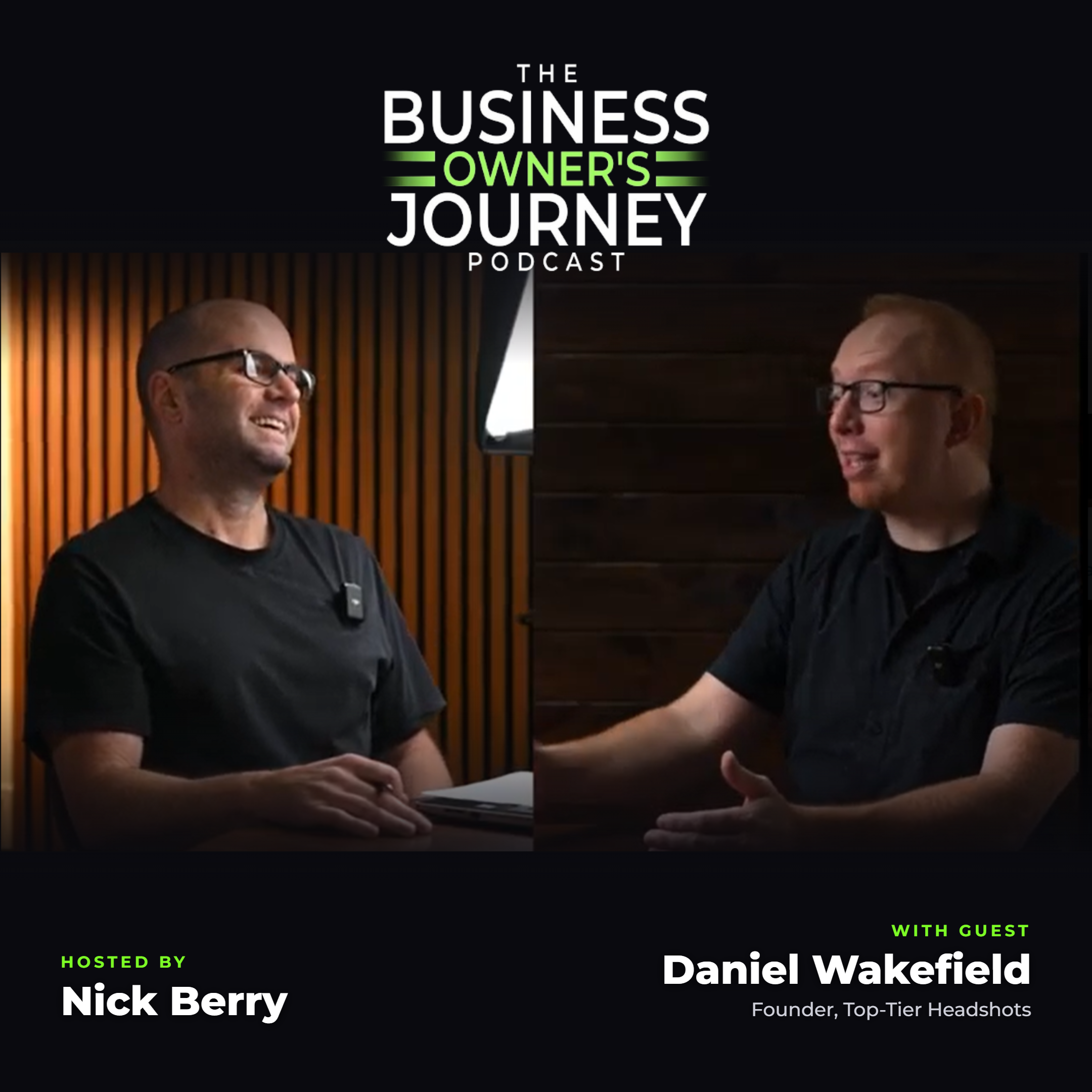


In this episode of The Business Owner's Journey, Nick Berry talks in person with Daniel Wakefield, photographer, entrepreneur, and founder of Top Tier Headshots. Daniel works with keynote speakers, founders, and executives on the visual side of their personal brands.
The conversation digs into what really happens when personal branding for entrepreneurs stops being an afterthought and becomes the business strategy.
Daniel went from a $50 month to a $50,000 month as a solopreneur. And then the next three months were crickets.
That crash forced a reckoning. Nick and Daniel walk through the founder mindset shift from producer to leader, whether a recurring revenue strategy is even possible in project-based creative work, and the business transformation strategy that tripled Daniel's effective hourly rate. If you're scaling a service business and feeling the ceiling, this one hits close to home.
Everything here comes from what he actually lived. He went through the burnout, made the identity shift, and rebuilt his business around brand positioning for founders. Here's what you can take from his story.
Daniel started Top Tier Headshots with one goal: give people the best headshot they'd ever had. But as he built his own personal brand on LinkedIn, he started bringing those same insights to clients. "Have you thought about trying this? It worked really well for me."
That's how a photographer became a brand strategist. Now clients reach out for a single headshot and leave the discovery call realizing they need a whole positioned portfolio. Daniel eliminated the disconnect that usually exists between the strategist and the photographer, because he's both.
That record $50,000 month came at a cost. Daniel was the CEO, the marketer, the salesperson, the producer, and the admin, all at once. Deliverables slipped. His LinkedIn content "fell off a cliff." The three months that followed were nearly silent.
Here's the pattern most founders miss. The business scaled faster than the leader did. Daniel had reached a ceiling where the best case was repeating that exhausting cycle. That's not growth. That's a hamster wheel with a bigger paycheck attached.
For years Daniel started every month at zero. Someone books a headshot, then doesn't need one again for a year or two. He assumed recurring revenue simply wasn't possible in photography.
Then a client joked, "Maybe I should put you on retainer." Daniel had already been quietly architecting exactly that. She signed. So did the client before her. The unlock wasn't forcing a model that didn't fit. It was listening to what clients actually needed and designing an offer that solved a real, ongoing problem.
For the first several years, Daniel didn't see himself as a leader. He was a producer and a service provider. That void showed up in real ways when he started building a team, sharing the reins with people who hadn't earned them yet, and saying "sure, good idea" without evaluating it as the owner.
The direction of the business blurred for months. It took hard decisions and strategic refocusing to recover. Daniel's takeaway is blunt: leadership isn't a silo that sits next to marketing and sales. It's the thing at the top that trickles into everything. The busier the business got, the more that gap cost him.
Daniel had capped his own revenue with an assumption. "Nobody wants to spend more than this." He offered an entry-level and a core package, but nothing bigger for the clients who wanted to go all in.
Want to know the worst way to price? Guessing what your clients will pay based on your own money story. The best way looks like Daniel's new visionary sessions, built around what executives, speakers, and authors actually need: keynote portraits, speaker reels, a positioned portfolio. One client added a speaking image to his LinkedIn banner and landed a paid engagement a week later from someone who had previously said no. The pricing follows the problem, not the other way around.
"It's about listening to what your clients are wanting and needing to solve their problems, and designing something that excellently solves that problem." — Daniel Wakefield
"You need to treat your personal brand as a must-have, not a nice to have." — Daniel Wakefield
"It's a danger that business owners can face, that we can make assumptions about things that couldn't be the furthest from the truth." — Daniel Wakefield
"People come in for a headshot, and they leave with a new vision for themselves." — Daniel Wakefield
"Everything you say yes to, you're saying no to something else." — Daniel Wakefield
You’ve built something valuable, but you've hit a wall.
You’re wearing all the hats, attending all of the meetings, making all of the decisions...
You’re not broken. You’re missing a clear picture of what to do next.
The 90-Day Roadmap shows you the path forward:
• Where you stand today in the 5 Stages of Business Growth
• The biggest issues holding you back and your top 3 opportunities to attack right now
• A week-by-week 90-day strategic action plan
It’s free. It takes under 6 minutes. And it delivers the kind of clarity most owners pay thousands for.
NOTE: This is NOT a stock, templated pdf with a few variations. This is a 1 of 1 analysis of your business.
This episode page also appears on
Medium.com.This episode is the subject of
this article on Perplexity.AI.This event is entirely free:
Eventbrite >>If you enjoyed this episode, please subscribe to the podcast on your favorite platform and leave a review. Your feedback helps us bring you more valuable content.
Follow us:
The Business Owner's Journey Podcast host: Nick Berry
Production Company: FCG
[00:00:00] Daniel: So a little over a year after I started my business, we had, at the time, our biggest month ever, and it was really, I mean, quite, astounding, and it felt incredible to go from a little over a year earlier having a $50 month total.
[00:00:18] Daniel: And then just a little over a year later to have a $50,000 month approximately. it was mind-blowing. [00:00:25] I was a complete solopreneur. , And the next three months in a row it wasn't no revenue, but it was crickets- Mm … comparatively,
[00:00:34] Nick Berry Daniel Wakefield - Intro Outro Monologue - Master audio: Daniel Wakefield is a photographer, an entrepreneur, and the founder of Top Tier Headshots. He works with keynote speakers, founders, and executives on building the visual side of their personal brands.
[00:01:55] Nick: There's been… I mean, I have my perspective, and I'm, I'm gonna share some of that, but I wanna hear from you. Uh, you know, what's the difference, what's happened in the last year that's made [00:02:05] such a big difference with you- Yeah … and your business?
[00:02:06] Daniel: how much time do you have? 'Cause there's, there's a lot of changes that have happened.
[00:02:12] Daniel: So, you know, I think kind of really just stepping back, really big picture, you know, where Top Tier started versus where it is right now. When I started the business, really my only goal was I wanted to give people the best headshot that they'd ever had. [00:02:30] And, and I set out to do that. I learned from the best.
[00:02:33] Daniel: I really, you know, spent time honing in on the craft, and the testimonials that I was getting from people, I think really were an evidence of that, that they were getting exactly what I was hoping that they would get, that really world-class level headshot, and something that would actually, you know, benefit their career.
[00:02:53] Daniel: It wouldn't just be kind of like a stale [00:02:55] placeholder. It would be, you know, this is actually opening doors for people. So that was really the goal when I started, and it's really evolved over the last five years. And I think really the last year and a half, two years in particular, uh, and then, you know, accelerating over the last year, I think that as I've moved along in the business that I've [00:03:20] really been zeroing in on the power of, personal branding, the power of positioning for my clients.
[00:03:30] Daniel: And it didn't just come out of nowhere. It was something that I was working on for myself as I was developing my own personal brand, as I was learning more about that and implementing things and growing my own brand, that I was [00:03:45] bringing those same insights and those same, things that I was implementing for myself, I was bringing those to my clients and saying, "Hey, we should try this.
[00:03:54] Daniel: This worked really well for me. Let's start thinking about this," or, "Let's go in this direction," or, "Oh, you're doing this. Let's position you like this." And just really starting to dive into my clients' brands and helping them take that brand to the next [00:04:10] level with much more than just a headshot. So we really started going all in on developing other styles of photography that had that same top-tier feel but were for different use cases, different situations.
[00:04:26] Daniel: and then also Diving deep into the brand strategy and what is it that you're hoping to achieve with these images? Mm-hmm. [00:04:35] And then how do we create images that amplify what you're doing? And so it's not just a collection of random, uh, images, but it's really a, uh, a really well-positioned portfolio that no matter w- you know, what image you use where, it's going to amplify the message that you're trying to get out there to your audience.
[00:04:56] Daniel: So that's really been a shift in [00:05:00] the focus of Top Tier Headshots- Mm-hmm … that r- really, you know, built it on the backbone of this really world-class headshot, but then realizing, wow, there's so much more here- Right … to dive into that I, that I love diving into with people and helping people with those things.
[00:05:17] Nick: Right. Yeah, when you put it like that, it makes sense, you should have a strategy in place, in mind- Mm-hmm … to be able to do the [00:05:25] world-class headshots or whatever the, the work is- Yeah … for the client. Do you think that you've always kind of done that? You've always had their brand in mind, and that's why you were able to do y- your work really well, and now you've just gotten really good at the, at the strategy part of it?
[00:05:40] Daniel: Yeah. Or
[00:05:40] Nick: did you not think maybe you didn't have it in place at all, and kind of learned it and plugged it in?
[00:05:45] Daniel: I think that it's, uh, both/and to answer to that [00:05:50] question. I think that at the very beginning, I was literally just, "Let me learn the craft. Let me get really, really good at the technical side of things, the coaching side of things," uh, which in itself was a very unique thing, um, for a
[00:06:06] Daniel: Most of my clients had never experienced something like that before. But I think pretty early on, I started to realize- Different [00:06:15] clients are trying to communicate different things. And so maybe for one client, the really warm, friendly, approachable smile is the way they need to go with their headshot as being a subset of their personal brand.
[00:06:31] Daniel: Whereas other people were really developing thought leadership, uh, really in more of like a leadership executive role, [00:06:40] needed to have a very confident, still warm, but very, very confident, very leadership type image. And so I started to coach people in different directions based on, you know, what they were telling me about their brand and what they're trying to communicate.
[00:06:55] Daniel: I would say that it's been happening for a while for most of my business, and it started happening because I was - and I think this is [00:07:05] an important lesson for every brand - is I was listening to my clients, and I was listening to what they were looking for. So it wasn't just a, "Hey, come on in, and you stand over here, and we're just gonna shoot this, and then there you go."
[00:07:21] Daniel: But it was a, you know, what are you trying to communicate with your brand, and then listening, and then, okay, how do we create these headshots that [00:07:30] actually will help? And so that no matter if it's a post or an article or your picture, you have an aligned brand-
[00:07:37] Nick: Mm-hmm …
[00:07:38] Daniel: across everything. So that started happening very early on.
[00:07:42] Daniel: so I think it's just kind of been a, a natural development, the longer I've gone, the deeper that I've gotten with that. And I think it was probably in the last year that I really started [00:07:55] to say, "You know what? That's something different that I'm doing, that perhaps many, uh, photographers are not doing, is I'm really diving deep into this brand strategy, and okay, how can we start to make this more intentional- Mm
[00:08:12] Daniel: as part of the process and not just something… Eh, you know, it might happen organically, it might not. But no, let's, how do we kind of [00:08:20] codify this and bake it into what we're doing?"
[00:08:22] Nick: Yeah. So then what effect has that had on Top Tier and on you?
[00:08:27] Daniel: Well, I think that, number one, it really helps me to get to know my clients better, because it's not just a surface level, "Oh, I'm gonna take your picture," even though it's not really ever been that.
[00:08:39] Daniel: it's gone deeper than that, so as a result, the relationships I think have deepened. but I think that it's [00:08:45] also the people that are coming in are not just looking for a headshot anymore. Or maybe when they first reach out, that's what they're looking for, but after a conversation they realize, "Oh, I need a lot more than that."
[00:08:58] Daniel: Mm-hmm. And so it's
[00:09:00] Nick: more- You think it clicks with them that, like, this is somebody who- that's different? there's more to offer here.
[00:09:03] Daniel: Yeah, so I mean, th- that comes out on the, discovery call. You know, they reach out [00:09:10] inquiring about getting some updated headshots, and I start kind of picking their brain about, about what their brand is like and about the different things that they're doing in their personal brand.
[00:09:20] Daniel: How are they putting themselves out there? Are they speaking? Are they podcasting? Are they writing a book? Are they, you know, all these different things. And by the time we're done the conversation, they realize, "Oh, man, We really need to build more of a portfolio and not just get, like, a single headshot that we [00:09:35] plaster everywhere.
[00:09:36] Nick: Mm-hmm.
[00:09:36] Daniel: Um, and so I would say that it's helped to position me as more of a brand authority and not just a photographer who talks a little bit about branding. Mm-hmm. Uh, and so people are coming to me, and my clients are coming back to me after the session, sometimes a long time after the session, saying, "What do you think about this?
[00:09:57] Daniel: And how should I do the… Well, how would you post about this?" [00:10:00] And then sometimes, you know, booking me again and coming back in because they're doing something new, and they want a new suite of images that reflects that new thing that they're doing. So it's kind of been about, I'm starting to become this, this brand strategist at, that's at the heart of everything.
[00:10:19] Daniel: And then people are coming to me for that, but then also to [00:10:25] execute all of the visual side of that because that's what happens, I think, far too often, is you've got people doing the strategy, and then they just send, you know, say, "Go find a photographer to do branding photos." And it's, it's a bit of a crap shoot, you know?
[00:10:42] Daniel: It's, is it gonna, you know, align with the brand strategy? Is there any communication at all between the strategist and the [00:10:50] photographer? So to have somebody who's both strategist and photographer who there's a there's no disconnect between this side of the brain and this side of the brain- Mm-hmm … um, so that we can create something that will actually amplify the, the strategy of what we're doing.
[00:11:09] Daniel: Or, you know, if somebody's working with a strategist already, I would love to have a conversation with them. [00:11:15] Yeah.
[00:11:15] Nick: So- Having somebody in your position who can have that con- that can communicate about the strategy and make sure that, that what we execute is, aligned- Yeah … with the strategy is, I know that's a huge relief for everybody else involved.
[00:11:29] Daniel: Yeah, 'cause, uh, you know, there are, there are people that come to me that they're already working with a, a brand strategist, and that's fantastic. and so I say to them, "Either I would love to have a conversation [00:11:40] with the strategist to make sure that the session goes exactly how they're hoping and wanting it to go, or just kind of let me know what they're saying and what they're…
[00:11:49] Daniel: if they have, like, a guidelines or, you know, a positioning statement or whatever that they have that they can give me so that we can go and be super intentional with the, with the session." So again, I think it's kind of a waste of money to just get a, [00:12:05] a suite of random images that- They might look decently good, but are they actually supporting the strategy?
[00:12:11] Daniel: Right.
[00:12:12] Nick: Yeah, I mean, what you're describing sounds to me like a, a dream scenario for a strategist and for the client. And for you, it probably falls in the dream scenario too. Yeah. If, if someone has a strategy or is working with a strategist- Mm-hmm … so they're clear, they can come in and they can tell you, "This is what's important to us right now."
[00:12:29] Nick: [00:12:30] Yeah. 'Cause not everybody can, right?
[00:12:32] Daniel: Yeah, yeah.
[00:12:33] Nick: to be able to eliminate that disconnect, that seems like a huge void that needs to be filled.
[00:12:38] Daniel: Yeah.
[00:12:38] Nick: and so it's changed some of what you do, it's changed some of who you work with.
[00:12:43] Daniel: Mm-hmm.
[00:12:44] Nick: Right? So how has that shown up in Top Tier?
[00:12:46] Nick: What, what's different about your business?
[00:12:47] Daniel: So I think, it's attracting, a new subset of people. I think I was attracting them already for the headshots, [00:12:55] but I think especially people that are founders or leaders that are waking up and realizing, like, a personal brand is not a nice to have anymore.
[00:13:08] Daniel: It's increasingly becoming a must-have. Just like, uh, my friend Nicole says, "You would never ask, 'Should I have an email address or should I not have an email address?'" Yeah. And this- that's an irrelevant question in this [00:13:20] day and age. Mm-hmm. And increasingly, the question, should I build a personal brand, is be- going in that same direction.
[00:13:27] Daniel: Uh, it's not a, oh, it would be nice, but it's not really necessary. Mm-hmm. It's more and more becoming a must-have- Mm-hmm … in this digital world that we're living in.
[00:13:36] Nick: It exists. It, it may suck-
[00:13:38] Daniel: Yeah. …
[00:13:39] Nick: but it exists.
[00:13:39] Daniel: Yeah, it's- One
[00:13:40] Nick: way or the other …
[00:13:40] Daniel: it's kind of a it, it exists whether you like it or not. Yeah. It's the [00:13:45] more of a, are you gonna be intentional about building it- Right
[00:13:48] Daniel: versus just letting it happen haphazardly.
[00:13:52] Nick: Mm-hmm.
[00:13:52] Daniel: So I think it's been increasingly Top Tier has been attracting that sort of client that sees the work, they see my thought leadership on LinkedIn, and they reach out 'cause they're curious. They, they want to work with somebody who's built a personal [00:14:10] brand before, they wanna work with a photographer who can help position them in a certain way.
[00:14:15] Daniel: So it, so it's all very intentional. So I think it's, it's been attracting, increasingly attracting that sort of clientele to the business, which is great. That's, that's, I think, the clientele that I especially love working with- Mm-hmm … and helping, helping with, uh, what I do. But I think that over the past year with these [00:14:35] developments, uh, there's also been really the growth of the team as well, and the vision of what could Top Tier Headshots be five years from now, 10 years from now.
[00:14:45] Daniel: if it keeps going in the direction that it is, it would be pretty impossible to run it as a solopreneur and to stay, uh, in that. And I think that, uh, the vision is bigger than that [00:15:00] anyways.
[00:15:00] Nick: Mm-hmm.
[00:15:00] Daniel: And so, uh, really over the last year, uh, we've done a lot of work on, uh, starting to build a small team of very, Very good people, good at what they do, values aligned with, uh, what we're all about at Top Tier, and, uh, building a team where I can increasingly, and it's…
[00:15:22] Daniel: there's still a lot of work to be done on this, but [00:15:25] I would say increasingly step back from some of the operations of the business to step into more of a leadership role, more of a, a visionary role, uh, in the business. Uh, you know, how do we take the business from point A to point B? Doing more of that and, starting to delegate more, uh, tasks [00:15:50] to people that are still very highly qualified-
[00:15:52] Daniel: for what they're doing, uh, and have proven to be excellent at what they do, but, uh, is allowing me to step into more of a leadership role.
[00:16:01] Nick: Mm-hmm. Yeah, so let's pull on that thread. Yeah. so we did our transformation case study about our, the work that I've done with you, and one of the things, that we brought to the surface in the last, year, [00:16:15] litt- little bit over a year, that you've been able to triple your, effective hourly rate, know, the value of your time. Mm. Um, and that's, you know, the details of that are, in the, transformation case study, but what I wanna talk to you about first is, like, what was it like then?
[00:16:30] Nick: What's… Let's talk about the difference in how life was for you then versus now.
[00:16:35] Daniel: Yeah. So a little over a year after I started my [00:16:40] business, we had, at the time, our biggest month ever, and it was really, I mean, quite, astounding, and it felt incredible to go from a little over a year earlier having a $50 month total.
[00:16:53] Daniel: Actually, it was 60 if you include the tip. You know, so-
[00:16:56] Nick: Which you
[00:16:57] Daniel: should. Uh, which I should. Mm-hmm. So $60 month, uh, and then just a little over a year later to have a $50,000 month [00:17:05] approximately. Uh, it was a little bit over that, it was mind-blowing. I was a complete solopreneur. I did not have a team around me.
[00:17:13] Daniel: Um, so I was 100% responsible for, you know, uh, the marketing, the sales, the, the production of the work, the delivery of the work, everything, the communication, the administrative stuff. There was a lot.
[00:17:28] Daniel: The C- [00:17:30] All the things. Yeah … the, the CEO, chief everything officer. Mm-hmm. so what happened in that month was the month finished, and it was like big sigh.
[00:17:39] Daniel: let me just ta- I'll take like a day off for a second and just rest," 'cause it was a crazy month. And what happened in that month was a lot of production happening, a lot of sessions with clients. [00:17:55] we even flew, we got flown to another state to do work, uh, during that time, so there was the, uh, additional, you know, exhaustion of having to travel and, uh, you know, there and back to, uh, to complete work.
[00:18:08] Daniel: And I was exhausted. My brain was going here, there, and everywhere trying to make sure that everybody got, you know, their deliverables on time, and things [00:18:20] started to slip through the cracks. Um, I wasn't getting back to, inquiries on the website or LinkedIn as quickly I wasn't doing… My, my LinkedIn content and marketing really fell off a cliff almost. It wasn't nonexistent, but it wasn't nearly what it had been in the months leading up to that. and just other, like, networking and other ac- just totally fell off a cliff.
[00:18:44] Nick: Mm-hmm. [00:18:45]
[00:18:45] Daniel: And so we had this incredible month.
[00:18:48] Daniel: I was completely exhausted, almost burnt out after that month, and the next three months in a row it wasn't no revenue, but it was crickets- Mm … comparatively, and it was kind of a, a bit of a wake-up call of wh- if we have a month like that again, what's it have to look like, what has to change so [00:19:10] that the next three months don't look like that again?
[00:19:12] Daniel: Right. And thankfully, after those three months, things had slowed down, so I really threw myself back into those, you know, marketing activities in LinkedIn and stuff like that, and it did bounce back. But it was a bit of a cautionary tale of, "Wow, this is amazing. Oh, crap. What's," you know, "the next three months in a row?"
[00:19:34] Nick: It looks [00:19:35] fantastic on the surface- Yeah … but then when you f- realize it, it's almost not worth doing-
[00:19:39] Daniel: Yeah …
[00:19:39] Nick: despite that.
[00:19:40] Daniel: so that was, that was happening. That was just kind of an example of, like, awesome month and then chaos and what was happening after that. And I would say the other big thing that was happening or, or not happening I should say, was I really didn't have a clear direction of, where do we go from [00:20:00] here?
[00:20:01] Daniel: It was just kind of a solopreneur, let's grow the revenue as big as we can and hope for the best. there wasn't a clear, like, pipeline strategy. There wasn't a clear direction of y- you know, what's the next step after this? There was a I would say a pretty bad, uh, shiny object [00:20:25] syndrome of, you know, because I didn't know what was next- Mm-hmm
[00:20:29] Daniel: it was kind of everything that looked shiny was, "Ooh, maybe that's something we could add into the business," or, "Ooh, that's something we could add in." And, uh, and a lot of it, looking back thinking, "That didn't even make sense. You know, why, why, why would I, you know, try to add that into the business? That's not even related to what we're trying to [00:20:50] do."
[00:20:50] Daniel: but when you're in the moment and you're consumed by everything and you're just trying to think through, you know, "How do I grow?" it's kind of, uh, the Wild West
[00:20:59] Nick: a bit. It is. You're right. Yeah, b- you've got… You need to survive.
[00:21:01] Daniel: Yeah.
[00:21:02] Nick: Uh, you gotta make sure that you live to fight another day, and you're, you're trying to figure out, like, what works and what doesn't and what should I do and what shouldn't I do, and there's not really a printed set of rules that anybody- Yeah
[00:21:11] Nick: has given you that says, like, red lights and green lights. Yeah. [00:21:15] You, you're trying to figure out what those are for yourself.
[00:21:17] Daniel: Yeah. And I think that something else that is an important part of the conversation as well is that we were basically starting every month from zero. There was zero, monthly recurring revenue happening in the business-
[00:21:31] Nick: Yeah
[00:21:32] Daniel: at all. Uh, be- and you know, my thinking was, well, somebody comes in for a headshot, and then they don't need one again for [00:21:40] however long, you know? People would ask me, you know, "How long, you know, how soon should I come back in for another one?" And I'd be like, "Well, come every month." But no, you know, realistically, maybe they only need one every year or every two years, or if you change your appearance, then yeah, do it then.
[00:21:56] Daniel: But, there was a very real sense of, you know, every single month it's hunting time. Mm-hmm. You know, starting the month of- Oh, okay … [00:22:05] it's just always a hunting mentality of, okay, we had a 50K month, fantastic. New month happens, we're at zero.
[00:22:14] Nick: Yeah.
[00:22:14] Daniel: Time to go.
[00:22:15] Nick: And that's typical for a photography business, right?
[00:22:18] Daniel: I would say so. I would say most people, most photographers, especially if, you know, just as an example, like a wedding photographer, that client, you know, you hope [00:22:30] for the best. They're not… don't need to come back in again and again- Mm-hmm, yeah … and again for their wedding photos. Yeah. and so, you know, you're relying a lot on, uh, you know, hunting- Mm
[00:22:40] Daniel: and marketing, and getting the word out there, and getting word of mouth from the married couple and to other people, and stuff like that. Uh, so there's, yeah, there's a lot of that that happens.
[00:22:50] Nick: So you're, we're starting from zero every month. Uh, got no [00:22:55] pipeline, and, uh, no strategy to- Yeah … tell you what to say yes or say no to.
[00:23:01] Daniel: Yeah.
[00:23:01] Nick: You're just kind of having to u- use your judgment and on every single thing that comes up. Like, there's no, filter in place yet.
[00:23:08] Daniel: Yeah.
[00:23:09] Nick: All right. So then what's, let's talk about kind of moving forward into the difference, or like, what, what's different now? Yeah. What's happened? Because all of that is different.
[00:23:17] Daniel: Yeah.
[00:23:18] Nick: Right? Yes. So talk [00:23:20] to me about that.
[00:23:20] Daniel: Oh, man. Where do I start? so I think that, uh, a little shameless plug for you, if you don't mind. Mm. Uh, working with someone to really start to help me think through the strategy behind the growth, and not just say- Because it was, it was very chaotic previously.
[00:23:43] Daniel: And there was [00:23:45] ideas and, and things, but again, it was all kind of shiny object syndrome. So working with somebody to really help me zero in on what are we actually trying to do in the business, where are we trying to get to, and what are the next steps that will help us to get there, has been invaluable for the business.
[00:24:05] Daniel: so I mean, any person that's out there that's started a business, a [00:24:10] s- you know, I think especially if you're a solopreneur and you're maybe doing a business for the first time, even if you've had some success, I cannot recommend highly enough working with somebody who has that, uh, experience already, who's, hopped over the obstacles, fought through the obstacles, knows where the landmines are to help you avoid them, can see the future, uh, [00:24:35] and, um, you know, help you really tighten up those goals and the steps to get there, has been just so incredibly invaluable for me personally.
[00:24:45] Daniel: And also to help guard against the, the shiny objects that are always coming in like, "Ooh, that would be so easy to make money that way." Mm-hmm. Yeah, the, and then the opportunity cost and everything- That's right … that happens there. So that's, I think, the first thing I would say. [00:25:00] and then I think the, another thing that I would say as well is just in terms of the, the growth of the business in terms of revenue r- I would say revenue and recurring revenue as well, to get even more specific, is I was really putting a cap on what my clients could spend with me and not really giving them a clear path [00:25:25] to if they wanna spend more, they can spend more.
[00:25:27] Daniel: They can, they can ascend into bigger things. And there was kind of a, you know, I was pretty good at getting people to, to move from, you know, just a one or two headshots into something bigger because I saw their need. It wasn't just a random, you know, used car salesman push you to buy more type of thing.
[00:25:47] Daniel: But, you know, seeing their brand that they're building, [00:25:50] their bigger need, and creating the variety that, that gave them the opportunity to invest more in their brand with that. But it was kind of capped at a certain level. There was kind of a, an entry-level offer and a core offer, but there wasn't really a big offer that was available for- Mm
[00:26:09] Daniel: for people who were interested in that sort of thing. And for a long time there wasn't, and I think [00:26:15] there was kind of a mindset issue of, well, you know, nobody wants to spend more than this. Well, who am I… That's, that's such a large assumption. Mm-hmm. And I think it's a danger that, that business owners can face is, you know, we can make assumptions about things that couldn't be the furthest from the truth. But maybe because of our past experience or, you know, the way that we grew up, whatever the case may [00:26:40] be, we limit ourselves to what we can do, to what our clients could spend, and, just really cap our revenue instead of just allowing it to grow if somebody wants to spend more.
[00:26:52] Daniel: Right. Give them the opportunity to spend
[00:26:54] Nick: more. They don't wanna… It's not about them wanting to spend money. It's about- Yeah … like what's the problem they want you to solve?
[00:26:58] Daniel: Exactly.
[00:26:59] Nick: And you're great at that.
[00:26:59] Daniel: Exactly. is there a bigger problem here that can be solved? so [00:27:05] I think that's a, a huge thing.
[00:27:07] Daniel: And then part of that as well was the assumption in my head of Recurring revenue's not really possible in this type of business. and then I started to wonder is it, but I started to architect it, try to figure it out, and it just never really felt like it was the right thing. And the thing that I think [00:27:30] fixed it was just listening to my clients and what they're looking for and what their needs are, and then realizing, oh, I think this would work.
[00:27:40] Daniel: Mm-hmm,
[00:27:40] Nick: mm-hmm.
[00:27:41] Daniel: And so just recently, it kind of organically came up in conversation with one of my clients that's come back in multiple times for their own head shots. I've done the head shots for their [00:27:55] firm. I've done branding images for, uh, for them specifically. we've developed a great relationship, and we're just randomly talking and she said something about this video company that they've got on retainer, and she jokingly said, "Uh, maybe I should put you on retainer."
[00:28:11] Daniel: And I said, "Well, actually, I was just, was working on coming up with something." And she said, "Okay, send me the details and we'll talk about it." And they just [00:28:20] signed. and that's actually the second one. Mm-hmm. There was somebody before that. So it just opened my eyes to, again, it's not about forcing something, you know, in that doesn't fit.
[00:28:31] Daniel: It's about listening to what your clients are wanting and needing to solve their problems, and designing something that, excellently solves that problem.
[00:28:41] Nick: Mm-hmm.
[00:28:42] Daniel: . So it was really about [00:28:45] me overcoming that assumption in my mind- Mm-hmm … of, oh, you can't really do recurring revenue in this sort of business. But again, that's just assumption. Right. If there are clients that have that problem, my job is not to convince somebody that they need to buy this package.
[00:29:06] Daniel: It's to simply listen to what their problems are, are, [00:29:10] and present to them an offer that solves that problem.
[00:29:13] Nick: Yep.
[00:29:14] Daniel: So-
[00:29:14] Nick: And the, and you know, from my perspective, the big difference, the big change in you that's opened that up is it's only how you think about things.
[00:29:21] Daniel: Mm-hmm.
[00:29:21] Nick: Right? you've shifted the way that you think about that situation in particular, but a lot of things, whether it's, uh, how you view your production, uh, versus having someone else do, be the producer, and that's [00:29:35] changed the way that you, uh, are building your team.
[00:29:37] Nick: Mm. the positioning for the business, yourself as a leader. that's one in particular. Let's talk about how you've changed your perspective on you as a leader from that before- Yeah … and after period.
[00:29:47] Daniel: for the first several years of my business, I didn't really view myself as a leader, to be honest. I guess, you know, okay, started this company, so kind of the de facto leader there, but [00:30:00] wasn't really viewing myself in that way. I think I was viewing myself more as a, as a producer and a service provider, um, and didn't really view myself in a leadership capacity.
[00:30:14] Daniel: So when we first started working together, and you were really pushing me to start thinking about a lot of these leadership things, and there was something in the back of my mind [00:30:25] that was thinking, " I don't… Do I really need this?" And I think it was, uh, just a mindset of I wasn't viewing my business in that way.
[00:30:34] Daniel: I was, I was kind of stuck in producer mode and stuck in thinking, "I just need to figure out better ways to produce, better ways to market myself, and then the, the business will grow that way." And there was really a, I think, a, a [00:30:50] vacuum created by not viewing myself as a leader-
[00:30:53] Nick: Mm-hmm …
[00:30:54] Daniel: in the business, and that started to show up in a not so good way when we started looking at building a team, and we started looking at who was gonna be on the team.
[00:31:08] Daniel: And kind of a
[00:31:11] Daniel: I would say unintentional [00:31:15] Not handing the reins over, but let's say sharing the reins with f- a person or people that hadn't earned the reins. And I was too quick to, basically say, "Okay, yeah, sure, that's a good idea," without really evaluating it, um, myself as, as the leader of the business. [00:31:40] And so that was, that was one of the ways that I think that that lack of viewing myself as a leader really started to show up-
[00:31:47] Nick: Mm-hmm
[00:31:47] Daniel: in Top Tier.
[00:31:49] Nick: It's like vibe partnering.
[00:31:51] Daniel: Yeah. that started to show up there were some setbacks. There were some, I would say, negative consequences of me not acting like the leader that I was I was the founder [00:32:05] of the company. Mm-hmm. I am the leader of the company.
[00:32:08] Daniel: and I wasn't really acting like it.
[00:32:11] Nick: Not in a negative way outwardly, just it, there was a void-
[00:32:15] Daniel: There was a void, yeah … that wouldn't even be filled. Yeah. I don't think it was a, "Oh, you're like a really harsh, critical leader." Right. It was more of just I was not really acting as a leader, period.
[00:32:27] Nick: Mm-hmm.
[00:32:28] Daniel: And the void. [00:32:30] and so that started to have some negative impacts. I think the, the direction of the business got blurred for a number of months as a result, and it really, it required some difficult decisions and some pretty strategic refocusing to get things back on track.
[00:32:51] Nick: So let's talk about that then.
[00:32:53] Nick: that being the, the [00:32:55] example that you've moved away from, right? That was, when you were not being a leader that you, that you feel like you need to be. T- what about now? W- how do you see yourself as a leader now?
[00:33:03] Daniel: there's an aspect of that in terms of, uh, decision-making that happens, and that might just be something that affects me and the, the, the business. It also might be something that, uh, affects the, the team that [00:33:20] we've put together, um, as well, and, uh, and then the interactions with the team.
[00:33:26] Daniel: Uh, so there's, there's that sort of impact. there's the impact of, you know, what if we have to, you know, essentially, terminate a team member, uh, for various reasons? and then it, it… I think it also shows up in the way that, that I lead my clients [00:33:45] as well, you know, that a lot of times, yeah, there's people that come in that still just say, you know, "I just want a great headshot, and can you do that for me?"
[00:33:52] Daniel: And, uh, but there's a lot of times there's clients that come in that really want my leadership in terms of, like, the brand strategy or my ideas or things like that. And so they're, they're kind of looking to me as a leader and an authority in, [00:34:10] in that sort of way as well. It impacts every area of the business.
[00:34:15] Daniel: It's not just a kind of silo, the leadership happens here, and then there's marketing over here, and there's sales over here. It's kind of the thing at the top that trickles down everything. it was a gaping void that needed to be filled I think the busier the business got, the more that void [00:34:35] impacted everything.
[00:34:36] Nick: Mm-hmm. Yeah. you were feeling that ceiling. You had, you had reached that ceiling. It, uh-
[00:34:41] Daniel: Yeah …
[00:34:42] Nick: kind of, we talked about the hamster wheel.
[00:34:43] Nick: you could repeat that little period of time like you described with the, uh, one big month followed by several that were, you know, you kinda paid for it.
[00:34:52] Nick: the best you were gonna do was repeat that.
[00:34:54] Daniel: Yeah.
[00:34:54] Nick: Which it really wasn't, you didn't wanna repeat. That, that was no way forward. now we've figured out how [00:35:00] to unlock things where you're able to, you have more leverage. Um, you can do much more than that in a period of time, uh, in a lot of directions- Mm-hmm
[00:35:10] Nick: not necessarily just revenue. Uh, and it doesn't come at such a cost to you.
[00:35:16] Daniel: Mm-hmm.
[00:35:16] Nick: Uh, so now you've built a machine, uh, that or are building the machine that's going to help take you to that vision that you've [00:35:25] gotten clearer on.
[00:35:25] Daniel: Mm-hmm.
[00:35:26] Nick: And so the machine itself is part of, the work that's been done, that's been created, but also, like, opening up the way that you think about things so you're able to pilot that machine-
[00:35:37] Daniel: Mm-hmm
[00:35:37] Nick: well.
[00:35:37] Daniel: Yeah.
[00:35:40] Nick: whenever I made the comment about the handcuffs?
[00:35:43] Daniel: Yeah.
[00:35:44] Nick: Yeah. Can you tell? Do you remember what the story was?
[00:35:47] Daniel: Uh, I don't remember exactly what we were [00:35:50] talking about. I think it was, if I remember correctly, it was something related to sales calls and me responding to every inquiry that came in.
[00:36:01] Nick: Mm-hmm. And
[00:36:02] Daniel: you said, you said- And, and I s- I was trying to make an argument for maybe I should go back to doing that. We had tried it with, uh, with my assistant kind of fielding the inquiry and [00:36:15] qualifying, and then me taking the calls that were serious, and she set it, she was setting that up. we, we had a month where there was a little bit of a dip in revenue, and I was trying to make the argument maybe I should go back to fielding all of those calls and just see how that impacts things.
[00:36:31] Daniel: And your exact quote was, "Would you like me to sign those handcuffs for you?" Which, which [00:36:40] made me stop in my tracks, and I was like, "Okay, point well taken." And I'll never forget that quote. I, that probably should be a LinkedIn post 'cause it's such a great… It'll catch people's attention. what we've found now is that the people who are really serious that wanna work with me, that we've done the work positioning ourselves to attract those sort of people, they [00:37:05] will absolutely take a call from my assistant and then get booked on a call with me.
[00:37:10] Daniel: And it's weeding out a lot of the people that they're, they're just price shopping, and they just wanna get a price and go on their way, and aren't really that interested in, in what I do specifically. So it's saving so much time-
[00:37:26] Nick: Mm-hmm …
[00:37:26] Daniel: on a monthly basis, where I, yes, I [00:37:30] still get on calls with people, but typically it's people that have already been qualified that they're, they're really interested in working with me and what I do, and not just people looking for a cheap headshot or the cheapest price on a headshot or something like that, I'll work with anybody that's willing to invest in their image.
[00:37:48] Daniel: But, uh, I think we're, we've built a business where a headshot is not just a throwaway item. It's [00:37:55] a, it's an investment into your brand. So we're not gonna be the cheapest person out there, and we're, we're totally okay with that.
[00:38:01] Daniel: you know, for me to get on the phone with somebody that wants a $50 headshot, I'm never gonna convince them to pay my price because their value is capped at 50 or whatever it is.
[00:38:12] Daniel: Mm-hmm. So, um, yeah, it's just a, it's something that has really month [00:38:20] over month saved me so much time and allowed me to focus on the clients that, um, that do actually want to invest- Mm-hmm … and are serious about building their brand.
[00:38:30] Nick: part of the reason why I really like that story is because I think it's a fantastic example.
[00:38:35] Nick: It, yeah, it gives us a, a really good gauge of how far you've come with your recognition of your role, especially as it relates to the [00:38:45] production. Hmm. Because that would've, like, taking those calls would've been the hardest thing to pry you away from before.
[00:38:51] Daniel: Mm-hmm.
[00:38:51] Nick: Right? And now we've gotten to a place where it's, we still need the occasional reminder- Yeah
[00:38:57] Nick: like we all do.
[00:38:58] Daniel: Yeah.
[00:38:58] Nick: And so, but that comment was all that it took, and you're like, "Oh, yeah," because now you're aware of it. Yeah. You're, you work on it intentionally, and your beliefs have shifted to where you, We're not just [00:39:10] saying it's important that you be the leader first. You believe that you- Yeah
[00:39:15] Nick: need to be the leader first, and you can still add value through production, but we're gonna be intentional- Yeah … about when that happens.
[00:39:22] Daniel: Yeah. And I think that It has really sharpened the decision-making when it's come to the, like, potential shiny objects. Things, you know, opportunities that come in [00:39:35] and, before it was, wow, you know, getting pulled every different direction because there were so many good ideas.
[00:39:41] Daniel: Versus now, able to see an opportunity, evaluate it based on what our goals are and what our priorities are in a given quarter, and quickly say, "Nope, put that away. It's a distraction," or, "Maybe [00:40:00] we can discuss it in the next quarterly thing, but right now it's a distraction from the current goals that we have, the current priorities."
[00:40:08] Daniel: So I think just the work that we've done has really helped to sharpen those things because as you've said a million times, if you start focusing on that distraction, what happens to the work? Opportunity [00:40:25] cost starts to suffer. You're taking backward steps instead of forward steps with what you're trying to do, and spreading yourself too thin, stuff like that, so.
[00:40:34] Daniel: Everything
[00:40:35] Nick: you say yes to, you're saying no to something else.
[00:40:37] Daniel: Yep.
[00:40:38] Nick: I mean, it's real, and it only… Like, that's only gonna continue. The opportunities, if, if this goes well, best case scenario, you're gonna actually get more of the best opportunities, so [00:40:50] discernment's gonna become more and more of a thing.
[00:40:52] Daniel: Yeah.
[00:40:52] Nick: that'll be the skill that we're sharpening at that point.
[00:40:55] Daniel: Mm-hmm.
[00:40:56] Nick: you have to think about this in term, like we're playing the long game.
[00:40:59] Daniel: Mm-hmm.
[00:41:00] Nick: The whole idea is to make it… Daniel's the guy that people want to work with, so we're, there are gonna be more people coming and wanting more and more of Daniel.
[00:41:08] Daniel: . Mm-hmm.
[00:41:08] Nick: But there's only so much of Daniel to go around. you've done well with it. It's not gonna go away. You're gonna keep getting better at it.
[00:41:14] Daniel: [00:41:15] Yeah.
[00:41:16] Nick: So considering everything that you've learned, in your growth, what would you tell somebody, another founder who is where you were, say, a year ago?
[00:41:25] Daniel: Number one, you need to talk to Nick. G- you will follow Nick. I,
[00:41:30] Nick: I don't disagree. But I, but I did not tell him to say
[00:41:33] Daniel: that. I, yeah, I was not getting paid for this promotion. Um, seriously though, go, go follow Nick on LinkedIn [00:41:40] and, you know, just a lot of his posts are adding a ton of wisdom. take advantage of the wisdom that he shares, what is it that you post on LinkedIn that's like a…
[00:41:52] Daniel: I can't remember what it's called now. The, it's like a blueprint or it's an audit or something.
[00:41:56] Nick: So there's the, uh, the five stages of the business owner journey. Yeah. So you have the 90-day, roadmap that you can get, or there's the five [00:42:05] ceilings assessment.
[00:42:06] Daniel: Yeah. One of those. So just, yeah, for people to take advantage of things like that, that you offer to your network and just add a lot of value and a lot of, I think, reveal a lot about your own business and what's happening and, and where, where the shortcomings are and where you need to, to grow and, you know, as a leader of a company.
[00:42:29] Nick: Mm-hmm.
[00:42:29] Daniel: [00:42:30] And not just be continually viewing yourself as the producer that's just gonna make everything happen. you know, especially if you're trying to build something more than just a lifestyle business, you know? which we are. so I think that's the, the first thing that I would say.
[00:42:44] Daniel: Um, another thing that I would say is you need to treat your personal brand as a must-have, not a nice to [00:42:55] have. Because, as Nick said, it's happening anyways, whether you like it or not, and so the question is really not a do I want it or do I not want it, do I wanna do this, do I not wanna do this? It's more of a, are you gonna be intentional about it or just let it happen haphazardly?
[00:43:16] Nick: Mm-hmm.
[00:43:17] Daniel: So I think that the, the [00:43:20] people that are forward-thinking in terms of their business and the market and the direction that things are going in the digital world, people are getting really serious about, "How do I build this personal brand intentionally instead of just letting it happen for me haphazardly?"
[00:43:40] Daniel: So that's another thing that I would say. Uh, and then I would also [00:43:45] say surround yourself with other growth-minded entrepreneurs. If you surround yourself with people that are always complaining about the way that things are or who are just very satisfied to just coast and not, don't really care very much about, uh, their personal growth, their professional development, and really [00:44:10] trying to take things to the next level professionally- That tends to rub off on people.
[00:44:15] Daniel: It has an effect. It has an effect. Absolutely. And I think every wise guru out there, uh, talks about, you know, who's the person who talks about, like, you're the, the average of the five people that you hang out with or you spend your time with? I can't remember who said that.
[00:44:31] Nick: I, I think it's popular. It's very common now.
[00:44:33] Daniel: Yeah. Yeah, it's very… I, you know, hear [00:44:35] it all the time, but I, it's definitely something that if you surround yourself with people that hold you back, they're gonna hold you back.
[00:44:42] Nick: Mm-hmm.
[00:44:43] Daniel: And so- Yeah … surrounding yourself, finding a, uh, a group of people that will really push you to the next level is vital.
[00:44:56] Nick: Yep, agreed. All right. So what, what does the future [00:45:00] look like for Top Tier and for you?
[00:45:02] Daniel: World domination.
[00:45:04] Nick: Exactly.
[00:45:06] Daniel: So, you know, because of the brand, the personal brand, because we've been building it in public on LinkedIn, it's getting an increasingly national presence. We've got followers, uh, from all over the world, the US mostly, but, but, uh, [00:45:25] followers from all over the world.
[00:45:27] Daniel: it's not uncommon now to have people fly in to Fort Lauderdale to, to do a session with me, uh, or occasionally have a team that flies me out to them to work with them with headshots or video or, or personal branding type, uh, images. So I think that, five, 10 years from now we've grown the team.
[00:45:49] Daniel: Still [00:45:50] want it to be a very white glove service, so committed to anybody that's part of the team really being trained at the highest level for, uh, for the headshots, for any images, for any video that we do for, uh, for our clients. you know, the direction that we've talked about, of really diving into the personal brand strategy, [00:46:15] that's gonna continue, and that, I think, is gonna get deeper, and there's going to be a standalone offer of personal brand consulting that, uh, people can hire me for, and that's going to be something that is also included in what I'm calling my visionary sessions, which we've really rolled out this past quarter, [00:46:40] which are a much bigger offer than anything that we've offered before.
[00:46:45] Daniel: And it's really designed for the executive, the speaker, the author that's really going all in on their personal brand and doesn't just want like a couple of images, but really wants to build a portfolio that really helps position them as the go-to expert in their [00:47:05] industry. And so anybody that signs up for one of those visionary sessions with the lower couple of tiers, there will be a, uh, a short brand strategy call to just make sure we're aligned before we kick off and actually do the, the work in the sessions.
[00:47:20] Daniel: But the largest tier of the visionary session will include a, a half-day brand strategy intensive where we basically turn the [00:47:30] phones off and get to work on what does your brand actually look like? Where is it going? Who is it for? What is it offering? All of the things that will really just sharpen what these people need to do.
[00:47:44] Nick: Mm-hmm.
[00:47:45] Daniel: Who they're for, what they offer, why they offer it, all of the things that, you know… And I talk to people that already, you know, they're bus- [00:47:55] they've got a business, they're getting clients, but there's a little bit of confusion still. Maybe they're not growing as quickly as they could, and when we dive into some of this branding and positioning stuff there's a lack of clarity.
[00:48:07] Daniel: Usually, I would say of, like, four or five main points that we cover, there's a, there's confusion on at least two or three of them. Mm-hmm. And it's cl- clouding up the whole [00:48:20] thing.
[00:48:20] Nick: Mm-hmm.
[00:48:20] Daniel: And so that's, uh, that's going to be a big direction for Top Tier is really diving into that strategy and then incorporating it into the studio sessions and beyond.
[00:48:32] Daniel: And some of the stuff that we're gonna be offering for the visionary sessions we're really excited about. Uh, I'm talking, you know, keynote coverage of your speaking event anywhere in the [00:48:45] US. speaker reels and what I'm calling keynote trailers to, to help you get more paid speaking engagements, uh, and get, get hired for those- Mm-hmm
[00:48:56] Daniel: and get noticed, uh, for those. And behind the scenes photography of what we do that just gives people a whole suite of social content that they can use to just show what it's like working with them [00:49:10] and, you know, all of the cool behind the scenes stuff- Mm-hmm … that happens there that people get curious about.
[00:49:14] Daniel: Yeah. And it just adds more value to what you're doing. So- You're
[00:49:18] Nick: solving the problem that we were talking about earlier- Yeah … that there's, that you didn't have the thing that solved that problem. You were thinking about it in terms of, like, ticket size. Yeah. Now you understand- Yeah … what your audience needs.
[00:49:30] Nick: And so you a- you already have some clients that you're working with that are in that space, right?
[00:49:34] Daniel: Yeah, [00:49:35] absolutely. That it's been really awesome to see some of the results that have been happening. So for example- And we can do some of this with the lower tier, like the designer session as well.
[00:49:47] Daniel: But for example, my signature keynote portraits that I developed that we do right here in my studio, because every single speaker client that I've worked with has told me, "I can't get a good [00:50:00] shot of myself while I'm speaking." So that was kind of the first, is that a problem I can solve? That, that is clearly being a cry for help from my clients.
[00:50:12] Daniel: So we worked on solving it. People are loving it. And I had the idea recently of, why don't we start putting some of those images in a LinkedIn banner for my [00:50:25] clients? So they've got a headshot in their profile picture and then a speaking image in their banner. And you've got something a little different there, but it's something that starts to showcase you in action, uh, what you would look like on stage, things like that.
[00:50:42] Daniel: one of my clients recently, uh, did the speaking shot, put it in their banner, a week later, got a [00:50:50] paid speaking engagement. And it was from somebody who previously had said no. Put the image, they said yes I mean
[00:51:02] Nick: Do the math. What
[00:51:03] Daniel: And, and, you know, I, I, I don't wanna just, like, pat myself on the back, but the guy himself, my client, said it is because…
[00:51:12] Daniel: Now, he was doing the work, he was [00:51:15] reaching out, he was applying for these things, but he said that the only difference was the speaker image in the banner. Mm-hmm. Positioning him as the speaker, that he already is, but it opened the door for that opportunity. Mm-hmm. So that's the sort of thing we wanna help people with, is to give them the brand foundation assets and all of [00:51:40] the, the marketing and social media content that helps to position them for success and that opens doors of opportunities for them.
[00:51:51] Nick: Yep, and I… You're doing it. Uh, I mean, I think I've said before, I think your, your work is so impactful, beyond what would've understood before. Uh, because you can change the way that people think about themselves.
[00:52:02] Daniel: Mm-hmm.
[00:52:02] Nick: Right? So, uh, for some people, [00:52:05] that's very important.
[00:52:06] Nick: They need to change the way that they think about themselves. Mm-hmm. For other people, maybe they just need images that are on par with how they think about themselves. Mm-hmm. But that's the thing that I've, I found with you that I'd not ever seen before.
[00:52:18] Daniel: Hmm.
[00:52:18] Nick: That I think, you know, you need to be responsible with that Yeah.
[00:52:22] Nick: That can be dangerous. I
[00:52:22] Daniel: know.
[00:52:23] Nick: Uh, but it's just, like, the impact that that can have on, on people you don't have to be in the market for headshots. It's not about [00:52:30] headshots.
[00:52:30] Daniel: Yeah.
[00:52:31] Nick: Um, I would imagine the, the person who you just mentioned who the opportunity came up after you put the speaking, um, image in their LinkedIn header, even before that instance happened, those images probably have affected how he perceived himself.
[00:52:47] Daniel: Mm-hmm.
[00:52:48] Nick: Um, and for the better.
[00:52:50] Daniel: Yeah. I've started to summarize it this way, because a lot of times, [00:52:55] especially with people that maybe they didn't know me as well when they booked a session,
[00:53:00] Daniel: what I've found is people, they, they come in for a headshot, and they leave with a new vision for themselves. And man, if that, if they get that, like, they can go and conquer the world.
[00:53:12] Daniel: And I've seen, you're right, some people come in, they're already a very confident person, and it just, it, you're, it gives them an aligned [00:53:20] photo that helps people see who they are, already are on the inside. And then there's other people that come in that they have big dreams, big goals, big plans, but there's something inside of them that says, "I don't know if I can get there.
[00:53:37] Daniel: I don't know if I have what it takes to get there." And there's something about seeing yourself looking [00:53:45] more confident than you've ever seen yourself look on a laptop screen staring back at you, that something inside starts to say, "Maybe I can do this." And that shifts everything.
[00:54:01] Nick: Yeah, it really does. It's one of the most powerful things, uh, for someone who's getting into es- trying to establish their personal brand.
[00:54:08] Nick: That moment [00:54:10] is one of the, key moments in that journey. Like, everything is different after that. So Daniel-
[00:54:16] Daniel: Yeah …
[00:54:17] Nick: I'm proud of you. You're doing a fantastic job. Uh, I appreciate everything. congratulations. Thank
[00:54:21] Daniel: you.
[00:54:22] Nick: speaking of, like, the power of having a vision, like, you're a testament to that, so I'm excited to see where you take things moving forward.
[00:54:29] Daniel: Yeah. Thanks for having me again.
[00:54:31] Nick Berry Daniel Wakefield - Intro Outro Monologue - Master audio: I hope you enjoyed the episode. If you want more on personal branding, check out my [00:54:35] episode with Joe Gannon.
[00:54:35] riversidenickberryraw-video-cfrnickberry0348: Joe runs an agency
[00:54:37] Nick Berry Daniel Wakefield - Intro Outro Monologue - Master audio: Amplify, and he's built personal for people like
[00:54:39] riversidenickberryraw-video-cfrnickberry0348: Ali Abdaal, Chris
[00:54:40] riversidenickberryraw-video-cfrnickberry0348: Williamson,
[00:54:41] Nick Berry Daniel Wakefield - Intro Outro Monologue - Master audio: and Sahil Bloom.
[00:54:42] riversidenickberryraw-video-cfrnickberry0348: He his
[00:54:43] Nick Berry Daniel Wakefield - Intro Outro Monologue - Master audio: framework, why he thinks ghostwriting is dead, and
[00:54:46] riversidenickberryraw-video-cfrnickberry0348: how AI is separating
[00:54:47] Nick Berry Daniel Wakefield - Intro Outro Monologue - Master audio: the creators from the noise. You
[00:54:50] riversidenickberryraw-video-cfrnickberry0348: on the
[00:54:51] Nick Berry Daniel Wakefield - Intro Outro Monologue - Master audio: of the business owner's journey,
[00:54:52] Nick Berry Daniel Wakefield - Intro Outro Monologue - Master audio: the ceilings of expertise businesses, and my parallel process at nickberry.info.
[00:54:58] riversidenickberryraw-video-cfrnickberry0348: week
[00:54:58]

Nick Berry is an American entrepreneur and business advisor, whose track record includes founding, leading, and advising award winning small businesses since 2002. He has built companies in multiple industries, hosts The Business Owner’s Journey podcast, and created the Business Alignment System™ framework that helps owner-operators scale without burning out.
After his most recent exit he founded Redesigned.Business to advise and coach to other entrepreneurs and business owners who are looking for a trusted (and proven) advisor.
Among peers, colleagues and clients, Nick has been referred to as 'The Anti-Guru', due to his pragmatic approach and principled leadership. He shares his thoughts, experience, and lessons learned each week in The Golden Thread newsletter.