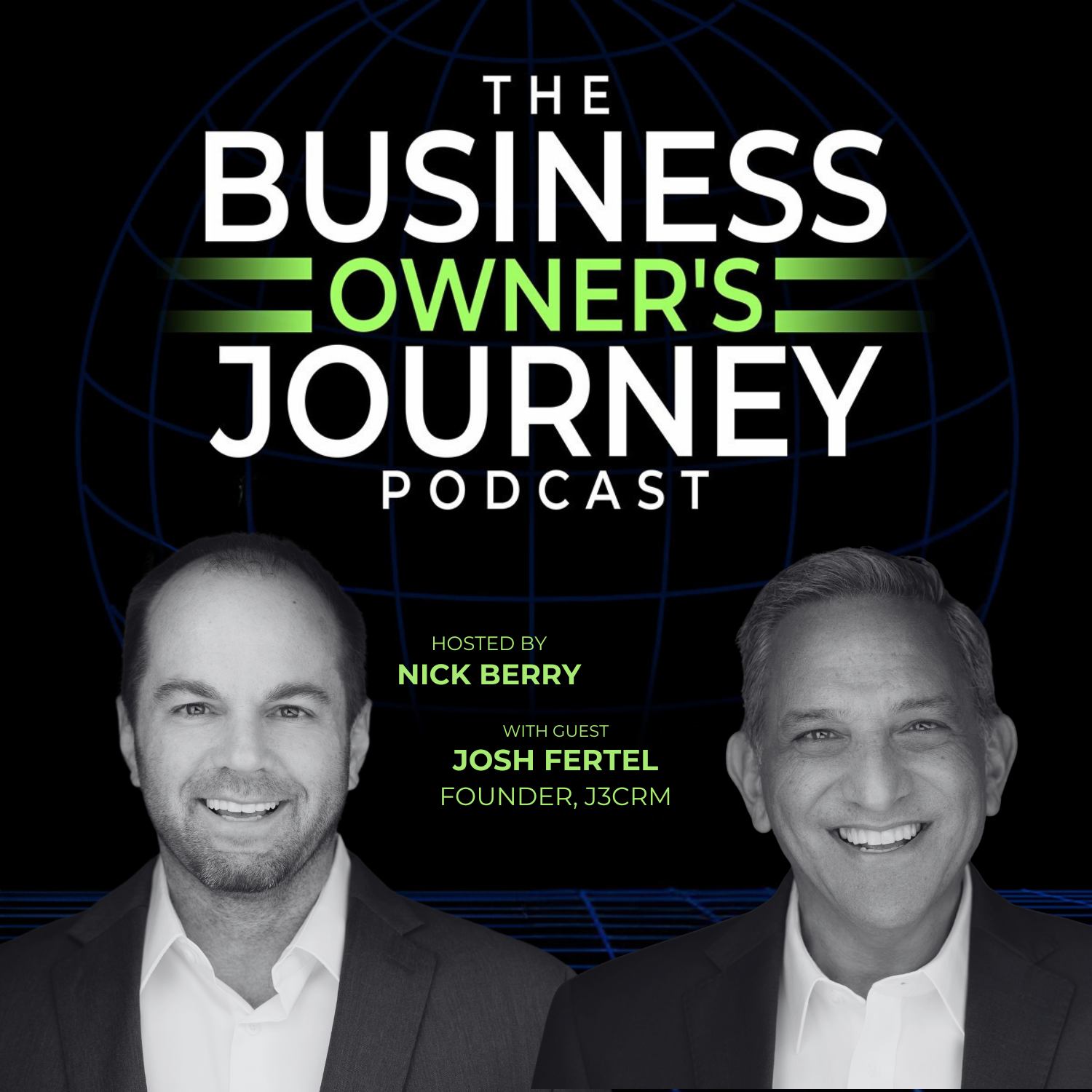


In this episode of The Business Owner’s Journey, host Nick Berry sits down with Josh Fertel, founder of J3 Revenue Cycle Management, to explore how smart revenue cycle management (RCM) can make or break private medical practices.
With over three decades of business acumen, Josh unpacks common misunderstandings physicians face around healthcare cash flow, explains how medical billing optimization drives growth, and gives his perspective on using AI and EHRs for better revenue.
Discover how a trust-based approach and modern tactics create real practice profitability.
Every business owner wants an edge, especially those in healthcare, where revenue challenges often sink promising practices.
In this conversation, Josh Fertel breaks down practical, actionable strategies that help private practices not just survive, but grow. So if you want to move beyond guesswork, Josh explains how clear numbers, stronger systems, and tighter communication turn medical practice profitability into something predictable.
Curious how the right RCM moves can safeguard your practice’s future? Keep reading.
Josh treats revenue cycle management like the foundation under the entire practice. When it’s stable, everything above it can function as intended. When it isn’t, even strong clinical care and steady patient demand can’t protect the business.
He explains that too many providers overlook the direct link between accurate billing and long-term financial stability. As he notes, “We are the engine of your practice,” reminding owners that mishandling cash flow or ignoring receivables can quietly undermine an otherwise thriving practice.
By installing clear systems and reimagining the role of billing, Josh and the J3 team have helped practices nationwide stay profitable in the face of shifting insurance landscapes and compliance challenges.
A surprising number of highly trained physicians miss the basics of running a business. Josh points out that most have extensive medical training, but almost none when it comes to practice management or revenue optimization.
The result? Revenue leaks, ignored reports, and outdated assumptions about receivables. Josh advocates for consistent financial education, giving providers the right questions to ask and teaching staff where true revenue lies (because that “expected receivables” number is usually fiction).
Practices that use straightforward reports and focus on genuine numbers, like those provided by J3, consistently outperform their peers.
AI in healthcare, especially when paired with EHR systems, promises to revolutionize how practices identify revenue opportunities.
But here’s the thing: most “AI enhancements” focus more on administrative tasks, not profitability. Josh’s team is working on EHR solutions that actively surface billing and care opportunities, pointing out, for example, when a patient may benefit from chronic care management (and when the practice can bill for it).
This reframes EHRs as growth tools, not just digital charts. And in a truly bold move, their forthcoming Forward EHR will be offered free to providers, removing a major cost barrier and supporting smarter, more profitable billing.
Patient responsibility accounts for nearly a quarter of income at typical practices. Yet, as Josh shares, front-desk teams often neglect these collections, leaving money on the table. His advice? Train your team, make financial expectations clear, and put real-time data right in front of providers when patients check in.
Simple traffic-light dashboards and transparent systems help teams prioritize what matters, ensuring nothing gets overlooked. Practices that prioritize patient responsibility collections boost cash flow and create a more sustainable business model.
What’s the secret to long-term client retention and genuine profitability? Trust.
Josh believes in treating every client like a business partner, sometimes taking on roles outside of standard billing to help practices weather crises or ramp up new services.
As he puts it, true RCM partners “answer every question, big or small, and care as much as the owner does.” This relationship-first approach not only reduces client churn but underpins the remarkable national growth J3 has achieved, without spending a dime on advertising.
"I always believe that every inch of a practice or any business needs to be generating income." — Josh Fertel
"We are the engine of your practice. What questions do you ask? What things should you be looking for in your office and outside of your office so you can run a business and be profitable and succeed?" — Josh Fertel
"You're in the insurance sandbox and they have all the toys and they change. They can change what they want to do whenever they want. And so we have to navigate that. It's our mission." — Josh Fertel
"But there has to be...there has to be a matter of trust. I'm not going to, I wouldn't have earned that trust on day one. I may have earned that trust on day 90." — Josh Fertel
You’ve built something valuable, but you've hit a wall.
You’re wearing all the hats, attending all of the meetings, making all of the decisions...
You’re not broken. You’re missing a clear picture of what to do next.
The 90-Day Roadmap shows you the path forward:
• Where you stand today in the 5 Stages of Business Growth
• The biggest issues holding you back and your top 3 opportunities to attack right now
• A week-by-week 90-day strategic action plan
It’s free. It takes under 6 minutes. And it delivers the kind of clarity most owners pay thousands for.
NOTE: This is NOT a stock, templated pdf with a few variations. This is a 1 of 1 analysis of your business.
This episode page also appears on
Medium.com.This episode is the subject of
this article on Perplexity.AI.This event is entirely free:
Eventbrite >>If you enjoyed this episode, please subscribe to the podcast on your favorite platform and leave a review. Your feedback helps us bring you more valuable content.
Follow us:
The Business Owner's Journey Podcast host: Nick Berry
Production Company: FCG
00:00 From Career Reinvention to Revenue Cycle Management
03:00 Identifying Private Practice Growth Opportunities
05:39 Medical Billing Optimization and Cash Flow Realities
08:17 AI in Healthcare and Electronic Health Records EHR Innovation
10:54 Revenue Cycle Management Business Model Explained
13:04 Increasing Medical Practice Profitability
15:24 Communication in Healthcare Billing Services
17:49 Trust, Partnerships, and Patient Responsibility Collections
20:33 Lessons on Practice Management for Physicians
Nick Berry (00:12)
Josh Fertel is the founder of J3 Revenue Cycle Management, a company helping medical practices increase cashflow and take control of their financials.
When Josh was in his early 50s, after he'd been successful in the automotive industry for several decades, he left that industry and walked away to build something new only to face a cancer diagnosis almost immediately afterwards. Instead of retreating, he reinvented himself, started another company and built a national healthcare billing company from scratch.
In this interview with Josh, you can expect to learn how revenue cycle management determines private practice survival.
What physicians misunderstand about healthcare cashflow. Josh's take on AI in healthcare and revenue optimization.
whether private practices can win in the insurance sandbox.
how to build trust-based client relationships that drive retention.
and how he's grown a national company using word of mouth instead of advertising. Enjoy this episode with Josh Fertel.
Nick Berry (01:03)
the first thing that I heard about was how nice of a guy you are and, and well spoken and an excellent writer, like why your content resonates with people, which these things have all proven to be true. But then I learned about your story and I think
Josh Fertel (01:12)
Thank you. Thank
Nick Berry (01:17)
The word resilience is definitely something that comes to mind. it's an interesting, sequence of events. I think you're in your early fifties, decide that you're going to transition out of a multiple decades career that you'd had a lot of success. Start a business. I mean, kudos for that. And then your diagnosis of cancer.
Josh Fertel (01:32)
Right? Right?
Correct.
Nick Berry (01:37)
and here we are. So tell me about your mindset as you went through that. Like how did you navigate all of that?
Josh Fertel (01:38)
Right.
It's, it's, ⁓ you know, you come to some point where the people that you're surrounded with influence you in different ways. And for me, it was when I got remarried and my second wife, she, you know, I have to say she thought that there was more to me than just working in a car dealer. And that's the easiest way I can probably put that. And she said, you have to go work for yourself.
Besides the fact that she hated the hours I was working, she said, you know, let's let's just see what you can do. And so I left, you know, just, you know, cold turkey and started the auto brokerage and did very well, built myself a nice book of business and was working from home and, you know, different kind of stresses. But I was able to spend a little more time, you know, with family and it was great. I loved it.
And what happened was when I had my surgery for cancer in 21, it wasn't that I was looking to leave and stop doing it and start doing something else. Although it was starting, you know, 30 something years in the same industry was starting to bore me a little bit. Let's put it that way. So I wasn't looking to change anything, but I wanted to spend the time that I was going to be recuperating to learn something new. And the reason for this is that many years ago,
I was going to go work for AutoNation in Weston. They were just building their building and it wasn't going to be open for an extra month. So I had a month off and I wasted the time. I really did. I think I paid in my daughter's room and sat around and ate and put weight on and I promised myself I would never do that again. So, you know, fast forward 20 something years, 25 years, no 21 years, and I was like, well, this is opportunity is going to be here again to just sit around. Am I going to do nothing or am I going to learn something new?
And I decided to learn something new. I've always been interested in the medical field. Definitely too old to be a doctor and go to med school. But since I was in the business world for so long, I was like, well, let me learn about that side. And that's where I started, you know, picked up my computer and took a class on billing and it went from there. So it wasn't, let's just say an accidental change and COVID at the same time did affect the car business a lot. So
I had extra time to work on it as things were a little bit slower, but it wasn't changing on purpose.
Nick Berry (04:02)
Yeah, at a certain point though, something was triggered in you that instead of you being maybe nudged toward this, in this direction, you decided you were pulled, right? At what point did you realize there's a problem that needs to be solved here and I can solve?
Josh Fertel (04:17)
It took me, it took a little while, right? There's certainly a learning curve to it. I surrounded myself with a team that had a lot more experience than I did, you know, 10 and 15 years. And as I'm speaking to business owners, which is private practice, they are business owners, you know, the, the lack of education.
in how to run a practice was really starting to dawn on me. And I had the ability to look through a different lens, you know, and say, okay, well, I've, you know, literally ran million dollar, multi-million dollar businesses. You know, you say, well, that doesn't sound right. And, you know, I can have a conversation in five minutes. like, the math doesn't seem to be working here. And you just pick it up and just be suggestive. And I think that a lot of that has helped with the growth of the company.
be able to say, okay, we're not just going to sit here and submit your claim and code them and hit submit. You know, we want to see you grow. And I think if you do these couple things or cut this here or hire somebody here, that's going to help you grow. And in return, you know, we're going to get our person, we're our partners in the business. So that's kind of what I saw. know, it's a shame that these providers go through so many years of school and
you know, certainly leave that school with debt and not once are they taught how to be business people.
Nick Berry (05:33)
Yeah, it's like the system's not really designed for them to be doing it in private practice. It's for them to be part of the system.
Josh Fertel (05:35)
Right.
Right.
So, you you go along and you explain what receivables are and where to find them and what to look and what questions to be asked and ask questions of us as your billing team. Where are the engine? Where the cash flow? Where the engine of your practice? What questions do ask? What things should you be looking for in your office and outside of your office so you can run a business and be profitable and succeed?
Nick Berry (06:04)
Yeah, it's remarkable for, mean, especially in the field that you're in, the clients that you work with, they can be so sophisticated and advanced in certain elements and still have such fundamentals missing in other areas.
Josh Fertel (06:20)
Right,
right. And they don't know a lot of times what they're missing. You don't know what you don't We don't know what we don't know. Why is it like this? And I have providers that have been 25 years in the business that are still that still ask basic questions. And it says, wow, gosh, you know, why is it taking 25 years for you to know that? Or why does it take 25 years for somebody to explain it to you even better? You know, and I feel good when we get our point across.
Nick Berry (06:25)
I mean, none of us do, right? We don't know, we don't know.
Josh Fertel (06:48)
And because you know, everybody's getting aligned, everybody's on the rails together.
Nick Berry (06:51)
So you kind of maybe got nudged in this direction, then you realize there's a problem that needs to be solved. I can solve it at a certain point. Like you got traction with it. now tell me about where, what this has turned into.
Josh Fertel (07:05)
What I found that first thing we have to do is provide the information to our clients. So a lot of times you'll be a billing company at the end, any billing company at the end of the month will send a report. Here's what we collected. Here's what's outstanding. And the provider will look at it. Maybe they'll know kind of what they're looking at or they're not. Anything with billing, you know, we… ⁓
your claim is two times to two and a half times what you're really going to collect when you're submitting the claims. So when you see a receivable number, it's not really what your receivables are. It's a fictitious number. you can make that anything depending on how much you want to set your claims for. So what's the real number? What am I really missing? What is it that I'm waiting for to come in? So we can send a report and there are there billing companies that'll send a 10, 12 page report of what happened for the month.
Honestly, you know as well as I do that's not getting red. Nobody's looking at it. They'll relook at the first page and they're gonna put it aside and then the coffee cup's gonna go on top of it and then it's gonna go in the garbage a few days later. It's never gonna be red.
Every practice has an EHR. EHRs really came into the forefront 2008, 2009. They have not been around that long, but there's been no renaissance in them. They're still used. Electronic health records. You go to the doctor, the information they're typing into the system of what they've done, what's wrong with you, how they're going to fix you, that's your electronic health record.
Nick Berry (08:18)
And EHR, I'm sorry, EH.
Josh Fertel (08:30)
And every practice used to be on a piece of paper early in the 2000s. They were still using those big folders that you saw when you walked in that are coded. in 2008, 2009, under President Bush, President Obama, they really pushed and paid hospitals to go electronic so that data and information could be shared.
Fast forward 17 years and all really it is now is still data being put in for a patient. Reports are in them. They all have reports, but finding those reports and finding the information for all this data that's being inputted to use it to run a business is near impossible. And I think I'm okay saying that. And you're paying a lot of money for this. Practices pay a lot of money depending on the system to get this information.
So what I came up with the idea of let's take the billing part, let's put the business part in front of the record. And so when I'm a provider and I log in in the morning, my financials are sitting right there, the things that I need to know. What claims haven't been paid, what's getting old, what patients are coming in that are gonna have to pay their copays today. So I make sure that we collect them. Not to go on a tangent, but…
patient responsibility is almost 25 % of the income and it's neglected. Your front desk is just such an important part. Let's keep an eye on them to make sure that they're trained to do right and that they have buy-in in the practice and they appreciate the service that the practice is giving to their patients so that they understand that patients have to pay and the patients know they have to pay, but you have to ask them.
So let's get that information there. Let's, know, what's in my account? What's my cashflow look like? One of my expenses, all these things. Let's just put it front and center with real information, real numbers, with traffic lights, nice and easy to understand. So in the morning, a provider knows where they are, business owner knows where they are. They can look at it really quick and then get on with their day.
There's the second part to that. Well, actually, let me go back. The most important thing about the EHR that we're creating for EHR is that we're going to give it away for free to the providers. It's not going to be a subscription model. As the billers, you know, we're going to be monetized by us doing the billing and, you know, a couple of other things that we're going to do, but there'll be no subscription model. And that can save a provider from a couple hundred.
to a couple thousand depending on the size of the practice. You shouldn't have to pay to find out how your business is going. You shouldn't have to pay for that information. It should be given to you, right? So many things, ⁓ technology is free. Google's free, Facebook's free. All these things are free. And they make their money in other ways. Let's do this for our providers. Let's not burden them with something new. And let's help start up, you know, a brand new provider. It's one less expense that they have.
Nick Berry (11:17)
Thank you.
Josh Fertel (11:21)
giving it away, that's the biggest part of it.
Nick Berry (11:23)
they can cut some of their costs of operating, but then they're at the same time, you're able to help them increase the top line. And then, the scope of your services,
Has the scope expanded now? Is it broader than financials? And now you're getting into helping them run their operations or maybe even broader than that. Like we're wall to wall business.
Josh Fertel (11:48)
I always believe that every inch of a practice or any business needs to be generating income. Right. So if you are, you know, they're all if you're brick and mortar, what are we doing? How can we use this space here to generate income and generate revenue for the practice? So I always look at things like that when I'm having a discussion. Any empty there's so many services that can be provided and so services to for practice, whether it can be. ⁓
chronic care management, which we do, advanced patient care that we do. You can do pulmonary services. You can do allergy services. There's so many things. A lot of them are cash paid too. Medical marijuana is a big thing now, if that's something that you want to get into. So many ways you can increase the top line that you just don't know and you don't think of. And so when
I or somebody like me can come in and say, here's an opportunity. What do you think about this? Let's have a discussion. I'm not benefiting from it, but I will in the long run. You know, my company, if my practice, if my clients are doing great, we're going to do well too. It just trickles down. So I want to enter, know, I want to, you know, feed up whatever can help them.
One of the things that our new software is going to do is when you're with a patient.
AI, we're going to. Right now, AI and Epic, who is the, you know, the godfather of all electronic records, says we're going to use AI and AI is going to help with coding and is going to help patients with scheduling. Just saw a video about it yesterday. All right. So my thought of first thought about that was, OK, so AI is going to help with coding. So what we're doing is we're eliminating every.
medical scribe, that whole industry is going to go away. It's just not going to be needed anymore. It's going to be affected. And we're going to help patients schedule, we're to help patients schedule their appointments. Okay, great. How is that helping the provider? I can't figure it out. Right. So good for you. You got AI coming. I don't see how that's helping your client, which is the provider. What I want to do is I want to use AI. So when the doctor is in the, the,
exam room with the patient and let's say that patient has diabetes or that patient has two chronic conditions, I want my AI to be suggestive and say, this patient has two chronic conditions, maybe they're a candidate for chronic care management. Should we proceed? Or if this person is overweight, you've coded this person, you've diagnosed this patient as overweight, do you want to do obesity counseling for here?
and hit OK. So it's not going make it. It's going make suggestions. All those little things add up on that same visit that that patient has. So it's going to teach the AI is going to teach the provider how to make more money.
Nick Berry (14:30)
Yeah. So it's just able to help the, the, uh, practitioner run through their, the progressions that they would be anyway. Right. Like they know these things, having them retrieved and being able to navigate through them quicker. And it's going to probably minimize some errors somewhere along the way. Right. And it ensures the completeness of them going through this like chain of thought. And that's where you're getting the additional, uh, know, finding the additional opportunities.
Josh Fertel (14:30)
Bye-bye.
Sure.
Correct.
Correct. And all those little things add up. All those little things up. You spend extra time with the same patient going over mental obesity, smoking, all these things add up. And it's just extra revenue for the same amount of work that you're doing.
Nick Berry (14:58)
for treatment. Okay.
OK, so you have.
software, Forward EHR is here or on its way.
Josh Fertel (15:17)
It is being built. So we are not in beta yet, but we are working on it as we speak here.
Nick Berry (15:25)
So then tell me about the growth of, J three. do you just call J three?
Josh Fertel (15:30)
I just call it J3. It's the worst name, but the more I've had it, the more we've had it, the more I appreciate it. So it is called J3 because J is for Josh. Three is my 3.0. As I was saying before, was a retail car business and I was an auto broker. So this is my third iteration. That's where the three comes from. RCM Revenue Cycle Management. So J3, RCM. So I've grown to love the name, although I did not love it at first.
Nick Berry (15:55)
I like the idea. Chapter three.
Josh Fertel (15:57)
Yeah, exactly. Exactly. We've we've been very fortunate in our growth. It's we've a lot of momentum. You know, LinkedIn has been very good. I'll be I'll be quite honest with you. LinkedIn is very good because it's helped me get the word out outside of my geographic area. I'm in South Florida. And for a long time, 90 percent of our ⁓ my clients have been in Florida. So now we are.
Nationwide, we do have clients in California, Oklahoma, and it's all been through word of mouth and through networking, not spent any money on advertising. But that's really that's the way you grow a business successfully. I've always said that I'm in a networking group. If you're not growing your business by word of mouth, you're doing something wrong. So we take it seriously. We have a vow to never lose a client.
We did of course like anybody else, but so far 2025, we have not lost a client and we don't plan on it and just continue to have growth. I think we're great communicators. That's the one thing I say that puts us really above anybody else is the quickness and the accuracy with which we communicate with our clients.
Nick Berry (16:53)
Fantastic.
Okay, well, that's a good segue to what I was going to follow up and ask you about. So the business is young, right? We're talking, we're four, have you hit five years yet? Yeah. Okay, so to get, especially considering like the way that it started to where you're at, it's not an accident. So, you know, what are the things, the either principles or behaviors that there's always something behind it, right? It's either, you can typically tie it back to the leaders, the way that they,
Josh Fertel (17:12)
Four years and some change, four years and one month.
Nick Berry (17:32)
their experience or their strengths or the things that they believe or the way that they are with people. I mean, the communication you saying we're great communicators that aligns with the Josh that I was told about before we met. what are the other things have been key to bringing J3 to where it's at?
Josh Fertel (17:49)
Well, you have to surround yourself with people and you have to create the culture. And I've gone through people. There are people that we have had that we had a good feeling about and it just didn't work out because the passion wasn't there. And yeah, I understand that submitting claims and dealing with numbers and health insurance all day is not the thing that it's easy to get passionate about. But I found people that have.
I try to lead by example. still have my, you know, up my sleeves every day and I get involved and I communicate with my team as to exactly what's going on, who we have that we could be onboarding, where the struggles are. I make sure that we answer emails and texts and we use every piece of communication possible with email, text, HIPAA compliant app that when there's a question that
our clients have that it gets answered. So really, anybody can sit here and say, oh, I'm a great communicator, but I really do believe it. And I really believe that when your practice is so reliant on the service that you're providing them, we are the foundation. And it doesn't take lightly. It's not lost on us what it is we do. If we don't do our job, the place…
Practice can literally have to close its doors if we're not doing our job. So we have to know that how serious is what we're doing. We have to appreciate that and communicate that to our clients. And when they know or when they feel that we're there for them, when they have their back, you know, it makes for a nice relationship. Specifically, we had a client who all of a sudden abruptly lost their office manager. And when you lose an office manager or when you lose an in-house billiard,
You're in the weeds, right? You're in the weeds and it's hard to find out. So I was like, okay, what can we do to help you? Not even, they're in Oklahoma. What can we do to help you to get through this until you find somebody else? And they were so appreciative of that. And we picked up the ball on things that we would not normally be doing just to make sure that they can just concentrate on patients.
Nick Berry (19:50)
So it's interesting. the building culture and making sure that you've got the right people on the bus and all that. When you've done it, you realize that there's a to it than the sure you talk about your mission and your purpose in some way. You're attracting people with more than just the
actual tasks that they need to do, the How do you describe the mission or purpose?
Josh Fertel (20:10)
They're my differentiator, I would say, from other groups. And certainly we are still a small fish in a big pond. There are those that are all 100 % overseas. And that's tough. Not that there's a bad job being done, but when it comes to communication, when it comes to time barriers, language barriers, it's difficult sometimes for a practice to do that.
The worst part about the billing industry is there is zero barrier to entry. Anybody with a laptop can be a biller, right? Sitting at your kitchen table, doing it part time while you're watching your children. There are a lot of companies like that. But we're not like that. We are a business and we treat our clients business like it's our own. So if we have a message is that, you know, we are partners.
And I say that when I'm doing my original presentation. Listen, you might not like what I'm about to say, but you and I are now partners. I'm a small percentage partner in your company. And that's how we're going to grow this together.
Nick Berry (21:09)
I love that. you are a business owner. You can relate to the element of their role or them being a business owner that like, not everybody is as invested in it as you are. And they're probably, if pushed, couldn't tell you anybody who's truly invested in it to the depth that they are. So,
Sometimes it means a lot to hear somebody say like, Hey, I'm in this with you. it's a lonely ride and you're looking for the people who will be bought in. Uh, even if it's not to the degree that you are as the owner, but so when somebody else comes in and says like, Hey, I'm going to treat yours the way that I would mine. I think that carries a lot of weight. Now I tell my clients like,
Josh Fertel (21:34)
Yeah.
Nick Berry (21:51)
I might be the only other person who's going to lose sleep over your business. And that's my way of saying the same thing that I'm a partner. It's like, don't want either one of us to leave. Yeah, I don't want, it's not like a badge of honor for us to not sleep, but the point is, I'm there
Josh Fertel (21:55)
Oh. We've definitely done that. Yeah, we've definitely done that.
Right.
was told, somebody said to me, said, you're always trying to be the hero. And I said, okay, I guess I understand what you're saying. But then I was like, you know what, I don't mind that. I do want to try to be the hero when somebody's got a big problem. If we take over a practice that is really struggling because the servicing wasn't good before and they are really struggling and we can give them a lifeline, I love that. I love being the hero.
Nick Berry (22:33)
Absolutely. Yeah, because I think the stakes are really high for that client, right? It doesn't matter how good of a practitioner you are,
Josh Fertel (22:38)
And sure, of course, of course.
And I even say this before. It's not a it's not a fair fight either when you are, you know, unless you're a cash pay, you know, practice, it is not a fair fight. You are in the insurance sandbox and they have all the toys and they change. They can change their what they want to do whenever they want. And so we have to navigate that. So we have to we have to. It's our mission. You know, anybody that does what I do or anybody that's.
in the health sphere of any kind, we have to enable these providers. We're not socialized medicine. We want to make sure that they're around to take care of the population. So we have to hand them all the tools. We have the ability to hand them. If I'm just one person and I can do one little thing, then great. Hopefully there's more people.
Nick Berry (23:22)
Mm-hmm.
Do you find that these private practices are generally receptive to hearing somebody come in and say, hey, you've got to pay some attention to this part of the practice or it's not going to work?
Josh Fertel (23:45)
I ask a lot of questions, I don't come across that way. I ask a lot of questions and I want the gears to start turning for my clients. And I'm very suggestive and very, know, soft close type of thing when it comes to making a difference.
Nick Berry (23:50)
Yeah.
Josh Fertel (24:04)
So, but here's an opportunity, here's how this works and this is how the math can work out. What do you think? And it's not like you need to do this, you need to do that. Because I don't them to think I'm like pushy guy and taking over or whatever. Again, we're in this together. Here's something that I saw work for one of my other providers. What do you think about this? This might be a good or here's an introduction to somebody that does this, that provides this service, which can bring you income.
and you're outsourcing, you don't have to hire anybody else for it. What do you think about this? Go talk to them, let me know. I have no skin in the game with that, but I'm just gonna give you all the opportunities and give you as many tools as I can for you to be successful. So that's kind of my approach to it, is to just offer up my knowledge for anything that, in my experience, for anything that I can do.
Nick Berry (24:50)
I would suspect that when it's approached well, like you just described, there are going to be some who are still like, that's not what I signed up for. That's not what I want to do. I don't want to deal with this stuff. But there are going to be a lot of them who are, if you can get the door open just a little bit, they're like,
Josh Fertel (25:08)
Right.
Nick Berry (25:08)
I can do things partially and try to stay in this lane and disregard almost neglect this element, which is really going to hold us back. There's a way to do all of this well that I'm not necessarily opposed to. And this guy knows how to do it.
Josh Fertel (25:23)
There has to be,
yeah, there has to be, and these are words we probably should have used earlier, there has to be a matter of trust. I'm not going to, I wouldn't have earned that trust on day one. I may have earned that trust on day 90 of working together, but not on day one. So for me to come barging in and say, you're doing this wrong, you're doing this wrong, you need to do this, do this, you know, anybody would take offense to that. But if we've done the job that we know we can do, know, 30, 60, 90 days down the road,
Nick Berry (25:29)
Hmm.
Josh Fertel (25:50)
and then we make suggestions on how to do better, nobody says no. They always listen.
Nick Berry (25:54)
Yeah. It's like if they're open
So before we wrap up, I want to circle back to the beginning of the conversation. You said that your second wife encouraged you to make a change because it-
paraphrasing here, but like she saw something there was more to you. There was something else. So what is it how's it manifesting? Are we seeing it now?
Josh Fertel (26:16)
I'm 60 something years old. I wish I knew then what I do now, but I'm not that guy that says I should have did this, I should have did that, I'm not doing that because I really believe that your experience gets you to where you are. You have to live your life before you can get to this point. I wish I was more of an entrepreneur instead of a W2 person. I wish I had learned that sooner.
But that's about it. know, I love working for myself and I never thought I would. And it comes from guidance. I, you know, to be frank, I had a stepfather who we weren't engaged that much. Not that we had a bad relationship, but he wasn't a guide. He wasn't a guide. So you need guidance. And I've learned to be able to do that with my children. And when you have that, you have somebody that's going to guide you, that somebody sees your potential and somebody that has faith in you.
It does it. changes everything about you. And really because of that, we're in good shape over here.

Nick Berry is an American entrepreneur and business advisor, whose track record includes founding, leading, and advising award winning small businesses since 2002. He has built companies in multiple industries, hosts The Business Owner’s Journey podcast, and created the Business Alignment System™ framework that helps owner-operators scale without burning out.
After his most recent exit he founded Redesigned.Business to advise and coach to other entrepreneurs and business owners who are looking for a trusted (and proven) advisor.
Among peers, colleagues and clients, Nick has been referred to as 'The Anti-Guru', due to his pragmatic approach and principled leadership. He shares his thoughts, experience, and lessons learned each week in The Golden Thread newsletter.