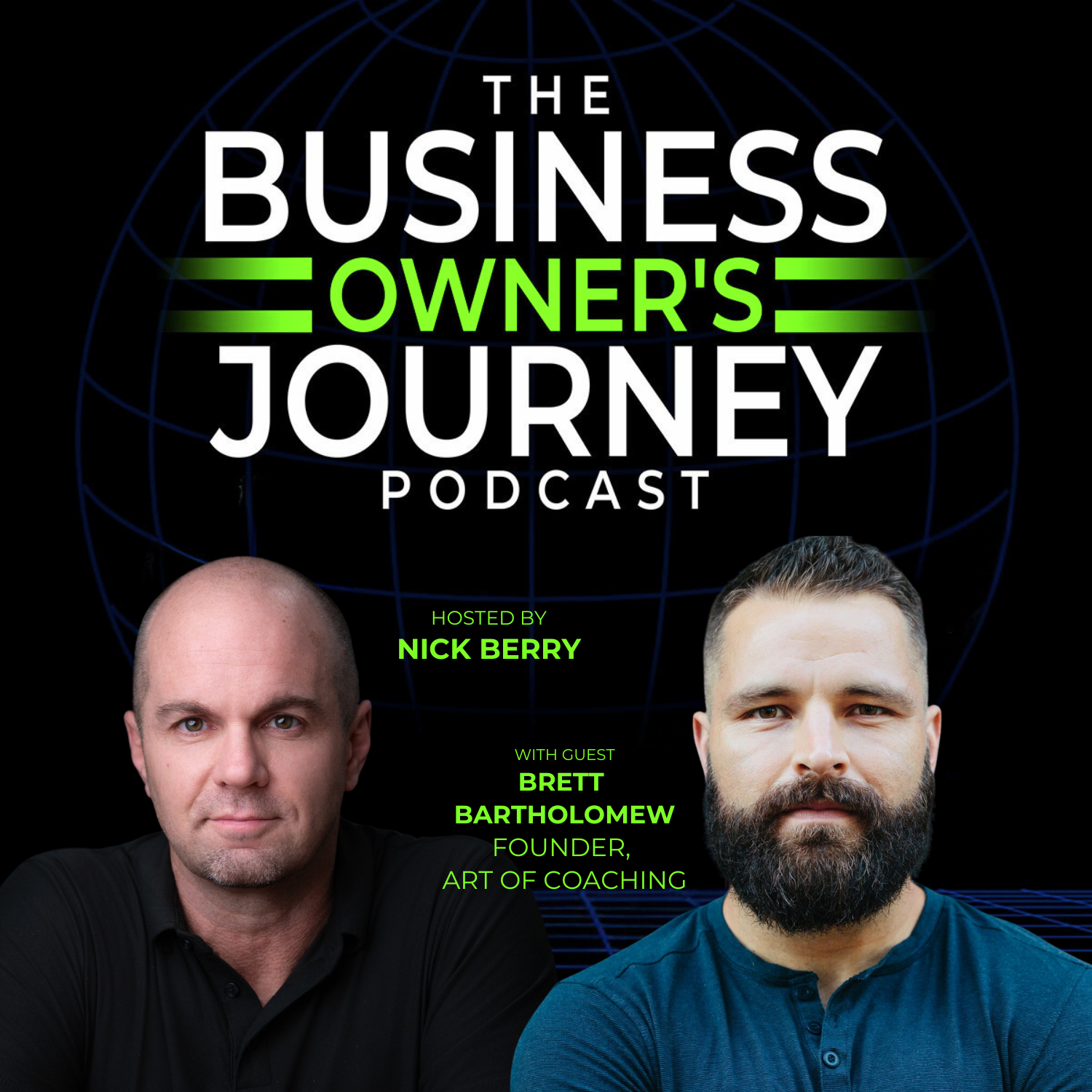


Most leadership advice sells you a fantasy. Be positive. Serve everyone. Stay liked. Then you run a real business and none of it seems effective. In this episode of The Business Owner's Journey, Brett Bartholomew, founder of Art of Coaching, a company which teaches communication strategy to leaders, best-selling author, keynote speaker, and renowned performance coach, makes the case that learning how to handle conflict as a leader is the skill that actually moves a company forward, because conflict is a nutrient that fuels real growth.
Host Nick Berry and Brett Bartholomew dig into leadership myths, the limits of servant leadership, adaptability in business, people pleasing in leadership, and the power dynamics at work that nobody warns you about. If you are a founder stuck between who you are and who the business needs you to be, this one hits where it counts.
These lessons matter because the founder is almost always the bottleneck, and conflict avoidance is one of the subtle ways that happens. Here is what Brett Bartholomew unpacks in this conversation, and why it should change how you lead.
Leadership myths set business owners up to fail because they promise one right way to lead that doesn't exist. Brett Bartholomew wrote The Anti-Hero Advantage partly to tear this apart. He points out that the optimized morning routine, the gratitude journal, the relentless positivity, none of it prepares you to lay off your first employee or fire a toxic staff member.
Brett Bartholomew shares relevant history too. George Washington got his ass kicked in the Battle of Brooklyn and had to retreat. Abraham Lincoln spent two weeks in bed with depression during the Civil War. These were real people who struggled, and the myth that leaders always know the right move is exactly what leaves founders feeling like frauds.
Servant leadership has limits, and Brett Bartholomew draws a sharp line between providing service and serving people to the point of harm. He ran a company with five staff members. If he had done everything for them in the traditional servant-leadership model, he wouldn't have built an autonomous team. He would have built dependency.
The same logic applies to clients. Brett Bartholomew says most of his clients come to him because they want someone honest enough to call out their biases. "I'm a respectful kick in the ass," he says. Taking care of people is not the same as doing everything for them.
Adaptability in business means reading the macro trend and pivoting the model before four quarters of bad numbers force your hand. Brett Bartholomew lived this in 2023 when his live event business slowed. He took it personally, wondered if he'd been canceled, then looked at the data and saw his virtual mentoring was doing better than ever.
He had identified so closely with the workshops that built his career that he almost missed how the business was evolving. His advice for founders watching one segment slump:
Multi-billion dollar companies do this five years too late. You don't have to.
How to handle conflict as a leader starts with reframing what conflict even is. Brett Bartholomew calls it an essential psychological nutrient. No conflict means no innovation, no discussion, and a hard ceiling on every relationship you have, at work and at home.
He separates conflict from hostility completely. Conflict in its purest form is just the intersection of seemingly incompatible goals or ideas. Whether it turns adversarial depends entirely on how two people choose to engage. Brett even has people role-play conflict scenarios, the same way lawyers run mock trials and the military runs war games, because almost nobody practices this skill before they need it.
People pleasing in leadership ends in paralysis, and Brett Bartholomew is blunt about why chasing likability is a trap. Make being liked your main goal and you get paralysis by analysis. You freeze, because someone is always going to be unhappy with a hard decision.
Brett is careful not to hand you a cheesy license to be a despot. The Anti-Hero Advantage is not about being an edgy jerk. It's about being a pragmatic realist who understands there are power dynamics at work and makes the call anyway. His fix: stop trying to be liked, be damn good at your job, and stay relatable, respectful, and mindful instead.
"Being an entrepreneur or business owner, in part, here's your soundbite, is a long-term commitment to some aspect of suffering." — Brett Bartholomew @Coach_BrettB Tweet this
"Conflict avoided or conflict deferred is conflict amplified." — Brett Bartholomew @Coach_BrettB Tweet this
"Conflict is necessary and healthy, and conflict is separate from hostility." — Brett Bartholomew @Coach_BrettB Tweet this
"You're more of a farmer than you are a business owner. You will not always reap what you sow, and that's the nature of the game." — Brett Bartholomew @Coach_BrettB Tweet this
"To be an effective leader, you don't have to be liked, but you also do have to understand there's power dynamics at play." — Brett Bartholomew @Coach_BrettB Tweet this
You’ve built something valuable, but you've hit a wall.
You’re wearing all the hats, attending all of the meetings, making all of the decisions...
You’re not broken. You’re missing a clear picture of what to do next.
The 90-Day Roadmap shows you the path forward:
• Where you stand today in the 5 Stages of Business Growth
• The biggest issues holding you back and your top 3 opportunities to attack right now
• A week-by-week 90-day strategic action plan
It’s free. It takes under 6 minutes. And it delivers the kind of clarity most owners pay thousands for.
NOTE: This is NOT a stock, templated pdf with a few variations. This is a 1 of 1 analysis of your business.
This episode page also appears on
Medium.com.This episode is the subject of
this article on Perplexity.AI.This event is entirely free:
Eventbrite >>If you enjoyed this episode, please subscribe to the podcast on your favorite platform and leave a review. Your feedback helps us bring you more valuable content.
Follow us:
The Business Owner's Journey Podcast host: Nick Berry
Production Company: FCG
Chapters
00:00 Hard Decisions for Business Owners
01:15 Why Brett Wrote The Anti-Hero Advantage
02:23 The Leadership Myths We're Sold
05:35 The Limits of Servant Leadership
06:55 Entrepreneurship Is Ambiguity
08:25 Adaptability in Business When Sales Drop
14:03 Why Conflict Is a Nutrient
17:11 How to Handle Conflict as a Leader
21:47 Three Types of Conflict
22:48 You Don't Need to Be Liked: Power Dynamics at Work
27:05 Becoming the Anti-Hero: Adaptability
28:48 Role-Play to Practice Conflict
31:12 Conflict Avoidance Amplifies Conflict
33:18 Where to Get the Book
[00:00:00] Brett: anybody that's led, truly led before, whether it's a team, whether it's self-leadership in their family or anything, they're never gonna feel like they're doing good enough. They need-- they're always gonna feel like they're letting somebody down. I think it's easy to forget sometimes the whole nature of making difficult decisions is they're difficult because somebody's gonna be unhappy, [00:00:25] [00:00:50] And so, [00:01:15] the bottom line is the impetus of this was, you know, I've owned a business, I've co-owned a business, I've ran a business, I've been a part of a business, and, I never felt like there was a book that when I needed to figure out how to navigate maybe a manipulative personality, a tough decision, ambiguity, self-doubt, that, that really spoke to the reality.
[00:01:33] Brett: I felt like I could find no shortage of motivational books, books that told me to do the fundamentals well. A-all of those things are well and [00:01:40] good, but something needs to be able to actually take you out of a world that is more Gotham than Eden and say, "Okay, what gets me back to base principles of, like, what I need to do to deal with the world as it really is?
[00:01:52] Brett: Oh, I mean, maybe I have a staff member that I need to fire that's become toxic. How do I not overanalyze this? Maybe there are some areas in my home where I'm not showing up the way that I want to. Maybe I'm, uh, over-accommodated, and I, I become a people pleaser. I'm, I'm in my own [00:02:05] head." So that, that's really what we needed to do, is find something that people could pick up and, and get them out of their own head, remind them that you're never gonna please everybody, you're not always gonna be liked, and get them back to making decisions, taking action, and being willing to do the unpopular thing sometimes
[00:02:20] Nick: yeah, that summarizes it. so where does it begin?
[00:02:23] Brett: The book? Yeah. So the, the first thing first is I think what... Like, you have to understand the problem, right? And the problem is, is we're sold kind [00:02:30] of this over-optimized why in society. Oh, like if you have the best morning routine, you have a gratitude journal, you have all this stuff, you know, you're just gonna be able to figure these things out.
[00:02:39] Brett: Don't worry, the world's gonna fall into your lap. There's one right way to lead. Just be a servant leader. Be positive. Make sure that you lead with confidence. Is that most people? You know, do most people walk around positive all day and, and knowing what the right decision-- And by the [00:02:55] way, what's the definition of the right decision?
[00:02:57] Brett: So let, let, let's get this straight, right? During COVID, there are certain organizations, both big and small, that had to lay off employees. Somebody today has got to lay off employees. They might have to lay off five hundred employees, might have to be five thousand, might have to be their first employee ever.
[00:03:11] Brett: What's the right decision? You know what I mean? How, how do you decide which-- Like, aside from the employees that maybe aren't performing and ones that you've given performance improvement plans to, like [00:03:20] what, what's the right decis- There's one right decision? Huh? There's a framework for that? And, uh, also, like, what, what does it mean if I'm not positive all the time?
[00:03:28] Brett: Oh, I'm not, I'm not meant to be a leader? Man, like George Washington and Winston Churchill and Martin Luther King Jr. shouldn't have led then because George Wa- Like, and the book talks about this. We go into what's the reality of leadership. George Washington always had to engage in strategic retreats, had to know when to give up [00:03:45] to go fight guerrilla warfare in another battle.
[00:03:47] Brett: He got his ass kicked in the Battle of Brooklyn. when we think about Abraham Lincoln, he was in bed with melancholy and severe depression for two weeks during the Civil War. Martin Luther King Jr. uh, committed infidelity and, and dealt with depre- like, uh, depression a- as a young person. John F.
[00:04:03] Brett: Kennedy, uh, abused both corticosteroids and barbiturates as part of his Addison's disease. [00:04:10] These were real people. W- what I just told you shouldn't make you disrespect or in any way, uh, should dishonor those people. They're real people that struggled with this. So a lot of the book talks about what, what are we sold as a bunch of bullshit about what leaders should be like and how to make the right decisions and how to behave all the time versus what's the reality.
[00:04:30] Brett: So the first part of the book excavates a lot of the historical [00:04:35] mythology we've been told about what it takes to lead so that people are like, "Oh, damn, this is relatable." Yeah, 'cause I don't always wake up feeling like I know the right thing to do. I don't always wake up knowing the right-- As a matter of fact, I second-guessed myself three times yesterday as a parent, as a partner, as a whatever.
[00:04:51] Brett: that's where the book starts because I think you have to start on terra firma and solid ground for people to really understand where some of the issues are and, and why some of these [00:05:00] other leadership books really misguide us, I think.
[00:05:02] Nick: You know, you gave all of those examples and, even talking about your personal examples, and it's like, well, of course they felt like that or they had out phase because what they're doing is hard. And that's the whole thing, I think, you know, with leadership is, is going to be hard. Maybe in varying degrees, but I don't think that you'll find many people, if anybody, who's gonna say like, "It's easy for me.
[00:05:23] Nick: Like my day is e-- my life is [00:05:25] easy." it's hard, and it's going to be hard, do you think that some of the problem is the perception that like, when I figure it out, that's gonna make it easier?
[00:05:35] Brett: I, I just think that the perception is that, again, there's one right way to lead. I mean, even look at, like, the book takes a big bite out of servant-based leadership. This idea that, like, if you just serve people, you give them everything they need, your staff To succeed, the organization's gonna do well, [00:05:50] just make sure everybody is, you know, has all the resources they need and they're locked and loaded.
[00:05:53] Brett: Well, of course, we need to take care of our staff. Of course, we need to make sure our people are served, but there's a big difference between servant and providing service. I had five staff members. If I did everything for them in the true axiom of traditional servant-based leadership as Robert Greenleaf wrote about it, I, I don't know that I'm creating a staff that's ever gonna get fully autonomous, but I'm creating dependency [00:06:15] issues, so my job isn't to do everything for my staff. My th-- my job's not to do everything for my clients, right? Most people reach out to me because they want somebody that's honest and straightforward about calling them out on their biases. I would say probably three-fourths of my clients are people that are like, "Listen, I don't have a lot of people that keep me in check."
[00:06:31] Brett: You know, they say I'm a relatively intense personality, or, you know, they kinda tell me what I wanna hear. I need somebody that's gonna help me understand my biases, get me out of [00:06:40] my own way. So I can do that. I'm a respectful kick in the ass that gives them a sense of pragmatism. But I just think that most people get into leadership thinking certain things, but th-they should really go into it perhaps thinking or understanding they're not gonna have all the resources they need.
[00:06:55] Brett: They're gonna have an incredible amount of turnover. It's gonna take three to five years longer than they thought. You're more of a farmer than you are a business owner, and those two go hand in hand. [00:07:05] You will not always reap what you sow, and that's the nature of the game, right? Is extreme ambig-ambiguity.
[00:07:12] Brett: some years you're gonna be crushing it. You'll be the belle of the ball. But most times you're gonna feel like, you can't make sense of the data of what's making your business work or not work. You've wasted money on ads that you were promised were gonna give you leads. and a lot of times your business is gonna be tied to how well other people are doing.
[00:07:29] Brett: [00:07:30] So you might be providing an excellent service, but somebody's going through a tough financial season, and whoops, now they gotta cancel their contract with you, and now you're back on the phone, right, when you thought you were saving up enough money to go to Disneyland. So I just think people need to understand, and I'm not trying to be negative, I'm trying to be pragmatic.
[00:07:47] Brett: Most people need to understand being an entrepreneur or business owner, in part, here's your soundbite, is a long-term commitment to some aspect of suffering. [00:07:55] You know, which is why it requires extreme adaptability, you know, and it requires, a certain kind of humility. It doesn't require Pollyanna, right?
[00:08:04] Brett: Like, "Oh, it's just gonna get better." Like, well, yeah, I hope it does, but also understand that it's not gonna get better unless you are willing to kill some sacred cows, get out of your own way, and figure out how to, make the most with the least, 'cause that's more often than not where you're gonna find yourself.
[00:08:18] Nick: Mm-hmm. What's that, [00:08:20] Elon's quote about it's like staring off into the abyss and chewing
[00:08:23] Brett: Shooting glass. Yeah.
[00:08:25] Nick: There you go
[00:08:25] Brett: Yeah. I mean, and I, I think, you know, it's a perfect example. Like, in 2023, our live event business was tanking compared to what it had done. And by live event, I mean we run certain leadership seminars, uh, speaker school. We run a course called Imperfect Relationships for people that are both married and divorced or single can [00:08:45] come and learn how to at least argue more effectively, or they learn more about intimacy and parenting and how to have hard conversations about money.
[00:08:52] Brett: And we were seeing a drop-off, and I was like, " Oh my God," like, "Did I somehow get canceled? Like, what is going on?" so I took it really personally, and I reached out to some of our clients, and a lot of them were just like, "Hey, man, it's a tough year. Travel's expensive, you know, my kids are starting school."
[00:09:09] Brett: And [00:09:10] I started looking at a lot of my clients in my age range. They were either having their second or their third kid, or you know, they were going through divorces, or maybe they just got married or they were changing jobs. But then I looked at the data, and this is a lesson for your audience. I was getting so frustrated about what had been our bell cow in our business for a long time, thinking something was wrong, but then I noticed, oh, on the other hand, another part of our [00:09:35] business is doing exceedingly well.
[00:09:36] Brett: Our virtual mentoring is doing better than it ever has done. And some of their other services are doing better than it's ever d- But I had identified so closely with these workshops, 'cause that was what had kinda gotten me to a certain aspect in my career and my business, that I had completely missed how our business was evolving.
[00:09:55] Brett: And I was like, "Wait a minute." And I talked to myself not so nicely. I don't [00:10:00] encourage that. I'm like, "Dude, you're an idiot. You watch CNBC. You hear how Apple has diminishing iPhone sales, and so they have to build another part of their business, or Chipotle's got diminishing lunch sales, so now they're making protein snacks that people..."
[00:10:15] Brett: And also, this is cyclical. This was one year out of eight. The next year, our mentoring might go down. And, and now ironically, our events have gone back up. Thankfully, right now we're [00:10:25] in a season where mentoring and our events are doing very well, and I'm thankful for that. Do you think I expect that to last?
[00:10:32] Brett: No. ' Cause the consumer goes through their own shit show, right? and I looked at it, I mean, even-- And I'm trying to give your audience real value here, so I hope I'm not ranting without giving specifics. Or am I doing okay to
[00:10:43] Nick: You're doing great. You're doing great
[00:10:45] Brett: So like for example, Some things might make sense for you to pull back on.
[00:10:49] Brett: [00:10:50] So we do this thing called the apprenticeship. It's all about leadership dynamics, how to have hard conversations. Well, I was looking at some of our contract, and I was like, "Okay, if people have a hard time coming to us, we can come to them, and we'll go to other states." So somebody can say, "Hey..." We did this in Denver.
[00:11:07] Brett: A guy was an architect. He goes, "I'd like, I'd like to host one. I have an architectural studio. You don't have to pay to rent the [00:11:15] space. You know, I, I'm happy to buy a spot for me and my staff. What other expenses are necessary?" And I'm like, "Well, nothing. If you buy X amount of spots, that's cool. We'll pay for our own travel.
[00:11:25] Brett: Just give us some reasonable lodging. Let us know where lodging is, right? I'll cover the flights. I'll cover my own meals. Look at this lodging." and then I was looking at that, and I'm like, "Oh my God. Flights are insanely expensive." And this was during, where there was big, uh, like tariffs [00:11:40] going on, and the Strait of Hormuz had just happened.
[00:11:42] Brett: And so my point is, is like for anybody listening right now who a part of their business or a segment's not doing well, look at what the larger macroeconomic trend is and then pivot. Is there a way that you can provide an ancillary service that saves you money and your clients money on travel costs but can bolster another part of your...
[00:12:01] Brett: Like these things are gonna pivot. But I think a lot of people know these things in terms [00:12:05] of economics, but they don't run their business accordingly. So what we do now is if there's a lot going on with macroeconomics and the price of oil and fuel is high, we might only run half as many events that year, and we might put out more promotions for our mentoring or something else where people don't have to...
[00:12:21] Brett: You know what I mean? You just, to a degree, you gotta gamble, and you gotta kind of meet the consumer where they're at and not get so angry about this stuff. That, that's a great [00:12:30] example of like the current shit show
[00:12:31] Nick: Mm-hmm. Yeah. And I mean, I think, maybe, uh, gambling might be strong, a little strong, like you- you... it's informed. But I think what you're really talking about there is how, how adaptable you're being, right? you know, you're gonna take whatever the calculated risk is, and it could be on a, a larger scale like that or, or something smaller, but it's...
[00:12:50] Nick: The, the being adaptable I think is key because if you imagine [00:12:55] the, the complex and uncertain path ahead of a, of a, an entrepreneur, no two days are gonna be alike for the most part. You'd better be ready to adapt
[00:13:05] Brett: No, right? And sometimes that means changing-- Like, we used to have five full-time staff. We found that that was not a great model for us. They were all remote. You know, it was kinda tough. you don't wanna police your staff, but it wa- it was tough to kinda know who's working on what and this, and you can have all the meetings you want about [00:13:20] culture.
[00:13:20] Brett: But, like, we run better now with a lean staff of contractors and people that, you know, kinda are at different life stages. And so when you talk about adapting, sometimes you need to change your whole business model, your staffing model. You've gotta be able to do the... And again, this sounds like common sense.
[00:13:35] Brett: It does to everybody, but you have multi-billion dollar corporations that won't do this. You know what I mean? And then they do it five years too late, and they're like, "Yeah, we're idiots. It finally took [00:13:45] four quarters of balance sheets to recognize that we had to do this or get rid of this CEO," or sometimes that might mean your spouse has to leave the business if you work with your spouse.
[00:13:54] Brett: We had a, a person present on that at our most recent conference who like, "The hardest thing I had to do was fire myself from the business 'cause..." everything's on the table
[00:14:03] Nick: Yeah. so that's an interesting segue 'cause the next thing I wanted to ask you about was conflict, and I think, I think one of the [00:14:10] things that I read, from you was conflict is unavoidable, mi- and misunderstanding is normal, and how that all factors into this
[00:14:17] Brett: Yeah, I mean, I, I think this is gonna be an unpopular view, but I think if people really dive into psychology and, and, and look at human nature and the way we've all evolved is conflict is a really essential psychological nutrient. Like, if there's no conflict [00:14:35] in the world, there's also no innovation, there's no discussion, there's no in- uh, the ceiling for any relationship, romantic, relationships, the relationship with your kids, anything is, is dependent on how well two people deal with conflict.
[00:14:48] Brett: And you have to understand that conflict is... A- all it is, is the assumption that we have misaligned values. Now, it can be we actually have misaligned values or, or that as well, but [00:15:00] think of it this way. Does it take much intelligence to find the differences in people or to find the negative in people or does it take a little bit more intelligence to be able to find common ground?
[00:15:11] Brett: Common ground, right?
[00:15:12] Nick: yeah, it takes, it takes something different to be willing to try to find the differences
[00:15:18] Brett: Right. And if somebody's like, "Well, that doesn't help me," I would say this, reframe it. It's more [00:15:25] miraculous that we don't have more conflict than we have in the sense like, Nick, can I read your mind?
[00:15:30] Nick: I don't think so.
[00:15:31] Brett: Can you read mine?
[00:15:33] Nick: Nope.
[00:15:33] Brett: like misunderstanding is the baseline. We walk around with eight billion other people.
[00:15:38] Brett: We don't know their intent. We don't know what they want. They don't know what we want, and so conflict is necessary to create a relationship. It's like tennis. It's like dancing. You've gotta find... It's gonna be awkward at [00:15:50] first. You gotta figure out a rhythm, gotta figure out your pseudo-opponent or your, the, the person next to you.
[00:15:55] Brett: But like when you think of it as like life is constant negotiation, coaching is constant negotiation, leadership is constant negotiation, how could there not be conflict? But we have a world that isn't taught that, so what do they do? They avoid conflict, and they shut down, or they personalize it, and they finger point.
[00:16:13] Brett: It's a fundamentally very [00:16:15] emotionally immature world, a very entitled, emotionally immature world. Go ahead
[00:16:19] Nick: Yeah. What, what I hear you describing, so the way you're describing conflict is that it's not adversarial, right? It's, I may even have called it, like, co-creation, but when you're, working on something with another party that you're having to figure out c- things about one another. Is that reasonable?
[00:16:37] Brett: Yeah. Well, I, I don't think conflict is [00:16:40] inherently adversarial, and I know, I think from what I'm hearing you, you're agreeing with that, like yes? Right. And so, like the term ... But the problem is for most people, it inherently evokes images of battles and arguments and hostility. Uh, uh, conflict in its purest form is just the intersection of seemingly incompatible goals, ideas, or actions
[00:17:02] Nick: Mhm.
[00:17:04] Brett: becomes [00:17:05] adversarial depends entirely on how two parties choose to engage with it.
[00:17:10] Nick: Угу
[00:17:11] Brett: You know what I mean? and I think that that is if, if people listen to no other part of this interview, it's that. when you think about the, okay, let's look at the core mindset of how most people think of it, win, lose, me versus you, right? Now, I don't always think there's a win-win.
[00:17:26] Brett: I don't even think if you were interviewing Chris Voss from Never Split the Difference, like [00:17:30] you end up splitting the difference most times. You know what I mean? It's a, it's a good title, you know, but you end up splitting the difference. If Chris Vo- I think Chris Voss might have had a marriage previously.
[00:17:40] Brett: He split the difference at some level. Okay? the primary goal, right, I think is where most people get it wrong, is like, "Oh, I gotta defeat this person," or, "I gotta bla-" Like they get defensive and they make it personal. It's like, no, no, like approach it with some level of curiosity. And I even, I try to practice this 'cause my [00:17:55] innate response if I hadn't worked on myself was like in my head.
[00:17:59] Brett: I did grow up in a family where it's like you'll get popped in the nose. You know what I mean? Like, Not by my family, but like this, these were values of like, all right, don't engage with a bully, but like the second or third time, you're popping somebody in the nose. And I've been punched in the nose.
[00:18:12] Brett: I boxed competitively in college. So it took a lot of work for me to work on active listening and empathy and [00:18:20] intellectual curiosity, 'cause my dark side wants to come out with a quickness. So I would work on this even when I would have trolls on social media. I'd be like, "Man, like you seem really up- what about what I said got you so upset?
[00:18:31] Brett: Like tell me more." You know? What, oh, what gave you that mentality? And I've also, it helps that I go around the world now. We role play this. I mean, so most people don't have any practice engaging with [00:18:45] conflict. They just go about dealing with it in their daily life. I think it's, that's kind of crazy to me.
[00:18:50] Brett: You know, almost to the, to the point that we take out recess from schools, sex education from schools, and then we also are not taught how to communicate under conflict. the ancient Greeks would do that. .The adversarial system was created, by the ancient Greeks. If you had a thought, you went into the town square and you stated your thoughts, [00:19:10] and then other people would come tell you where you're...
[00:19:12] Brett: But you engage in that. It was normalized, right? It wasn't like, "You're an idiot for not sharing my views." it was just part of the deal. Like, "Hey, state your views, but be ready to defend it, and this is part of healthy society." And I don't think we have that anymore. I don't think it's, I don't think it's looked at like that.
[00:19:27] Brett: I think we look at it as a very weird adversarial in the opposite sense of the word
[00:19:31] Nick: Yeah. So the, uh, what comes to mind is it seems to be very common to [00:19:35] me that just this, the stigma or the preconceived notion that people have about, around the word conflict turns into the first obstacle that you run into when, when you're trying to, engage. if you come in with a neutral perspective and another person responds to that receiving it as if it's, adversarial, you've just added an additional layer that has to be sorted out
[00:19:58] Brett: Right. I mean, [00:20:00] I, I think a lot of it is sorted out when people just understand conflict is necessary and healthy. don't confuse conflict with hostility. Conflict is, I would literally call it like an engine for progress, right? Like, you have to have friction. Like, we'll, we'll talk about evolution in nature, which clearly comes from friction.
[00:20:18] Brett: An animal not adapting to its environment, over time, we understand how that gives way to evolution. But, like, we don't [00:20:25] see conflict interpersonally as productive friction. And I mean, I think if most of your audience was listening and, or if most of your audience, sorry, was not listening, was honest, they'd say probably some of the best sex they ever had came from initial conflict.
[00:20:39] Nick: We'll
[00:20:40] Brett: I had to give you one. I had to give you one. Guys, if you don't know me, one, I love Nick, and I'm, I'm playful to a fault. I went into this being like, "I gotta make this [00:20:50] dude crack up once and be like, 'Did he just say that?'" So sorry if that goes against your beliefs, but I mean, hey, hey, listen. Listen. This isn't...
[00:20:57] Brett: If I wasn't doing this, if you were like, "What would you do if you weren't teaching conflict resolution and commu-" I would be a sex therapist, so, like, it's true to brand. I am who I really am, okay? And I'll take it a step farther. Most people in life think they're better at two things than they really are: [00:21:15] communication and sex.
[00:21:16] Brett: So this all goes hand in hand. You're welcome.
[00:21:19] Nick: Yeah, yeah, uh, that part I, I believe that. So a-
[00:21:22] Brett: He goes
[00:21:23] Nick: and you need to go to Brett's social media profiles and ask him your sex questions
[00:21:27] Brett: Yeah, there you go, 100%, 100%. But does that make sense getting back to the point of like, I, I think I don't wanna give people cheesy taglines of like think win-win, 'cause I think that is bullshit. Like, that's, that's cool, but like [00:21:40] you're not gonna think win-win. There's gonna be a hybrid solution. Again, conflict is necessary and healthy, and conflict is separate from hostility.
[00:21:47] Brett: Some conflicts may involve hostility, but that is not synonymous with conflict. That's what we bring to conflict. And the reality is most, most conflict becomes hostile not because of interpersonal issues between two people but because of internal issues. You know what I [00:22:05] mean? Intern- Like, there's very, there's different types of conflict.
[00:22:07] Brett: There's internal conflict. I'm wrestling with a, a, a moral choice for my own self-image. There's interpersonal conflict. you, let's say you and I aren't getting along, and then there's conflict that's contextual. Like, it's the situation. I don't have enough money to do what I want or, you know, I'm only given 30 seconds to state my view.
[00:22:25] Brett: And these things are all, they lead into each other. [00:22:30] Sometimes that contextual conflict, "Oh, like you're not giving me enough time to state my view," leads to internal conflict, "Oh shit, now I'm doing a bad job 'cause I'm rushed", and then that makes me angry at the person. You know what I mean? Do you see how these things kind of touch together?
[00:22:43] Nick: Mm-hmm.
[00:22:44] Brett: So like nobody likes conflict. Certain people just understand it better
[00:22:48] Nick: Mm-hmm. they have a different goal in mind. What about the, the need to be liked or the feeling, I think this was maybe one of the myths [00:22:55] that you mentioned at the very beginning of our conversation, that, uh, to be an effective leader, like, you, you need to be liked
[00:23:00] Brett: Yeah, you don't. You know? I think that you need to be cognizant that you're not gonna be understood. It's like that Nina Simone, "I'm just a soul whose intentions are good." Sing the rest. Go.
[00:23:14] Nick: I can't, I'm, I wouldn't, not going on after that. Are you
[00:23:17] Brett: know what I was saying?
[00:23:18] Nick: I'm an
[00:23:18] Brett: was really-- Yeah. [00:23:20] Folks, I'm single. Um, but I think, most of your audience is mature enough to know that even if they sold ice cream, somebody's gonna bitch about being lactose intolerant, And I think the struggle is, not that people don't know they're not gonna be liked. I think they feel like they're not gonna advance within their job or accomplish their goals if they're not, and there's some truth to that, by the way. Right? Like there is some truth to that. If you're-- [00:23:45] Nobody's saying, "Oh, you don't have to be liked, so walk around and be a despot," right?
[00:23:50] Brett: Like my book, The Anti-Hero Advantage is not like, "Oh, just be an asshole and be edgy." That's not what we're talking about with the concept of the anti-hero in my book. We're talking about a very pragmatic realist, somebody who's adaptable. They're gonna play in the gray. They understand that, again, you're not always gonna be liked.
[00:24:08] Brett: You're gonna have to make difficult [00:24:10] decisions. So if somebody were to ask, "Well, okay, you're saying you don't have to be liked and you're not gonna be liked, but not being liked cost me my job 'cause the general manager just fired me and hired somebody that they like. Now what do you have to say?" I'd say, "Well, yeah, listen, I'm still gonna stand by my point.
[00:24:27] Brett: To be an effective leader, you don't have to be liked, but you also do have to understand there's power dynamics at play," which is another big part of [00:24:35] the book. And so what you can balance that with, if you're not liked, is you better be damn good at your job, you know. Because the world's best brain surgeon probably isn't getting fired because he doesn't have a whole lot of bedside manner.
[00:24:48] Brett: He's gonna get complaints, he or she, right? but you have to build a unique skill set, and that's gonna buttress that. But my point when I say you don't have to be liked is you have to quit trying to [00:25:00] make that your main goal, 'cause that's just gonna lead to people pleasing and paralysis by analysis.
[00:25:06] Brett: But you do need to be relatable, you do need to be respectful, and you do need to be mindful. Those aren't the same things as being liked by everybody. Did I make that point clear, or was that a
[00:25:18] Nick: Yeah, I think that's great. Yeah, it's, uh, a nice to have, not a have to have
[00:25:23] Brett: Yeah, I'm not for [00:25:25] everybody. You know what I mean? I'm not. I, I speak in a very direct way. Now, you know me, but I, I say this at the beginning of any talk I give. I say, "Hey, I just wanna give you..." I usually say, "Thank you for having me." Of course, I'm a Midwesterner, I'm always grateful. but I'm like, "Here are some things on how to receive me, since we don't know each..."
[00:25:42] Brett: I just did this at a Ritz Carlton leadership summit. I'm like, "I'm, I'm very direct, but this comes from a place of respect. I have 60 [00:25:50] minutes to talk to you. I'm gonna cut fluff, give you the need to know for the now. I've wasted a lot of my own time and money watching people spout off eloquent words and beautiful frameworks, and ultimately not tell me a whole lot of anything.
[00:26:03] Brett: I'm coming from a place of respect. There's an intensity in which I speak that just comes from this matters a lot to me. You know, I nearly died in part due to poor communication, so I'm kind of in my zone. don't [00:26:15] mistake my directness for being punchy or a know-it-all or combative. That's not where it's coming from."
[00:26:20] Brett: that's one of the things we teach people at our speaker school, is one of the best things you can do when leading or speaking or, or, or meeting somebody, is give them information on how to receive you. You know what I mean? You know me well, like, so, like, I don't think I need to buttress that.
[00:26:33] Brett: Like, I know I'm an intense dude, but you know that's not me trying to be the dominant... I don't wanna be the dominant personality in [00:26:40] the room. I don't wanna be the dominant personality in my relationship. I want a companion, and I want the same thing with colleagues and coworkers and collaborators. But, like, my tone of voice and my appearance makes peop-- Now, I can, I can be that.
[00:26:52] Brett: Like, don't get it twisted. If I need to step into that role, I'm very comfortable with conflict. But that's not how I'm trying to live my day to day. This is just how I am
[00:27:03] Nick: all right, I'm gonna, I'm gonna shift gears and kind of [00:27:05] go, like circle back to the book. So what's the purpose behind the book? Like, what drove you to write the book?
[00:27:12] Brett: Yeah, I mean, everything we've talked about, by the way, is, is related to the book. So you've done a wonderful job navigating that part of the conversation for sure, is there's a whole chapter on what we just talked about. Like, how do you overcome these internal adversaries, in the book, we, we talk about internal adversaries as [00:27:30] the people pleaser, the overanalyzer, the perfectionist, and several other internal conflict archetypes.
[00:27:36] Brett: So I just wanna make sure that that's clear for anybody listening. but the whole point of the book is literally how to become the most adaptable version of yourself so you can make the most change, right? The, the anti-hero is the point of, like, you think about somebody who can explore the full range of their personality.
[00:27:53] Brett: They've kinda been through their own [00:27:55] darkness, they've kinda danced with their demons, they've failed, they've taken their lumps. Contrast that with, like, if somebody's like, "Well, why, why that other than, like, the hero?" Well, we talk about in the book, the heroic blueprint is what you're sold. Go ahead, try to become the most optimized version of yourself.
[00:28:11] Brett: Go ahead, walk around positive all the time. Y- you know it's not how you really are. I mean, they wouldn't make movies like Inside Out if we were [00:28:20] all just positive and joy was the end. You're not relatable. You know, you're gonna come across like a jackass, and you're gonna come across as preachy. And, and who, who relates to that?
[00:28:28] Brett: Who relates to perfect? Who's really perfect? Who is this? And like, so most leaders get burnt out because they're trying to be that person. They're trying to be, like, the perfect leader. That's what we call the heroic blueprint, instead of being the most adaptable, wide-ranging, [00:28:45] realistic, pragmatic, down-to-earth, straightforward.
[00:28:48] Brett: and so that's what we talk to them. But you can't become that anti-hero version of yourself until you realize, okay where am I hiding from some reality? I'll give you a great example. we were speaking to about 400 folks in the military, and we were getting ready to do social scrimmaging, which is what we call our role play, where people choose a conflict-based scenario, they find a partner, and they work through it with some constraints.
[00:29:09] Brett: And none of it's [00:29:10] like cheesy water cooler, "Hey, Diana, you were super rude by the water cooler yesterday. Let's talk about five appropriate way..." It's not that shit. It's like actually mirroring a conflict, no different than athletes would scrimmage. It ain't really fourth and one with 20 seconds left, but we're gonna pretend it is because we're gonna see how you behave in that scenario, and we're gonna give you tools to kind of iterate.
[00:29:33] Brett: Imagine that. You're gonna do what lawyers [00:29:35] do when they do mock trials. You're gonna do what the military does when it does war games. We're gonna practice this, and we set the clock for two to three minutes. But bottom line is one woman's like, "Well, I don't wanna do this. I think it's make-believe and I think it's stupid."
[00:29:48] Brett: And I write about this in the book, and I'm like, "Well, appreciate your honesty. Walk me through this." You know, and I'm trying not to, 'cause I'm very imperfect. I'm trying not to talk to her about all the research of how improv [00:30:00] and role play and again, just practice. And like, that would be like saying having a real-life hard conversation is pointless, 'cause that's what we're practicing.
[00:30:09] Brett: You know what I mean? And you're practicing that so you can get used to the emotions, you can get used to this, and at least more used to it than... Like, my, my retort to most people is, "Okay, if we don't do this, then what?" You know what, what actually gets you just having the discussion, eating shit, failing, [00:30:25] looking like an idiot, getting mad?
[00:30:27] Brett: Like what's the answer then? 'Cause people either do nothing or they go to therapy. we can't practice this? I didn't say any of that. I just let her explain herself, and eventually she kinda talked herself out, and I asked her a question and, and she said, "You know what? To be honest, I'm just not comfortable with conflict.
[00:30:42] Brett: That's why I don't like it." And I praised that honesty, you know? And I said, "Well, but why? Why are you not comfortable with conflict?" 'Cause a big part of [00:30:50] the book asks people to explore this, which is probably why the book won't become a bestseller because people don't like to self-interrogate. They'd rather be given like the th- five R framework or some shit. You know what I mean? And then they read it, and they go to the next book and the next book, and they gobble it up like Lucky Charms, and in 10 years they haven't learned shit because they're just like reading the equivalent of like a TED Talk in a bottle.
[00:31:12] Brett: But like we're like, "Why do you run from conflict?" [00:31:15] "Well, you know..." And she's like, "Like previous training in the military taught us this and that." Okay, so it's either beliefs that you were raised with. You know, like my ex-wife was very honest about something 'cause she, she, she would admit if she was on the show she didn't deal with conflict well.
[00:31:29] Brett: she was like, "In my family, like if you stated an alternative view, people always got pissed, so you just learned to keep your mouth shut." I try to teach my six-year-old son, "Buddy, you should always voice your [00:31:40] opinion," because if you keep your mouth shut, now you're creating avoidance, now you're creating withdrawal, I'm not labeling them as such. The psychology research labels those as immature defense mechanisms. Why? Because conflict avoided or conflict deferred is conflict amplified. You know what I mean? It's okay if your innate tendency is to try to avoid conflict. It's okay if your innate tendency is to withdraw, [00:32:05] but you have to understand that's not a real solution.
[00:32:07] Brett: If, now, if you need to say, "Timeout, I can't process this quickly or as quickly as you, and I wanna respond thoughtfully. Can we talk about this more in 10 minutes?" Now, you're not always gonna get that. that-that's fine if you wanna talk to your significant other that way, I encourage that, but, like, your boss isn't always gonna give you 10 minutes to process.
[00:32:26] Brett: You know what I mean? And so I think that people need to self-interrogate and be like, "Oh my [00:32:30] God, like, what is my innate tendency?" Like me, we have an archetype in there called the counter puncher. I tend to fire back really quickly. Why? Well, because I care a great deal about what I do, and so if you criticize me on some shit, I'm gonna tell you all the ways I thought about it, and I'm gonna rationalize.
[00:32:45] Brett: That's not any better, you know, but, like, I'll at least engage with it. But I have to work on that. So again, this is kind of the process of becoming the [00:32:55] anti-hero, is you have to explore your relationship with conflict, internal and external, your relationship with who you are, the-the models and molds you're trying to live up to that probably aren't fitting you, that are a result of a lot of these societal narratives, and you gotta do some work to figure out, " how do I not be that anymore?
[00:33:14] Brett: And how can I become this other version of myself?" And that's what the book guides them to do
[00:33:18] Nick: So let's talk about [00:33:20] the book, the timeline, when it's coming out, what else you have going on with Art of Coaching, all things Brett Bartholomew
[00:33:26] Brett: Yeah, I mean, the book is out for pre-order now, and so people can go to Amazon or the antiheroadvantage.com or just antiheroadvantage.com. I'm recording the, audiobook. So if you like it when authors narrate their own book, I am doing that. the book will physically ship out December [00:33:45] 1st, so if you're listening to it now, get it while it's hot.
[00:33:47] Brett: we were lucky to get the endorsement of folks like General Stanley McChrystal, who led the United States Special Forces against Al-Qaeda, Steven Pressfield, and, and many others. And I don't say that to flex, I say that because I was scared shitless to reach out to these people who didn't know me. I was scared that people wouldn't bet on a book that, fundamentally is about a pragmatic struggle we're all gonna deal with, and, and [00:34:10] thankfully these folks did.
[00:34:11] Brett: So I promise this book has been vetted by people that would call it bullshit if it was bullshit. It's not a perfect book, but I, I promise you this: you're gonna be hard-pressed if you engage with it honestly to not find something that can help you in your marriage, your relationship with your kids, your, your other relationships with your family, or your business.
[00:34:31] Brett: Right? Like, I, I guarantee it's gonna help you in at least [00:34:35] one of those areas of your life, because I worked my ass off on it. You know, I did. And so, I appreciate it, Nick. I appreciate you giving it the time of day and, and giving me a platform to talk about it, because books like this I'll tell your listeners flat out, guys, they, my publisher, Portfolio Penguin, talked about they don't take calculated risks on books like this often because positivity sells. Five steps to health, wealth, and happiness sells. Books that ask [00:35:00] people to do work on themselves don't, because people don't wanna do that, right?
[00:35:04] Brett: But this is the book that you give your colleague at happy hour when they're bitching about their manipulative boss, and this, 'cause this book will also tell them how to deal with those people. Um, so if you want a book that's just very grounded, honest, real, flawed, but ultimately practical, you're gonna like it
[00:35:19] Nick: I'm excited about it. I'm looking forward to getting my copy of I mean, you mentioned it to me. It was almost two [00:35:25] years ago we did our first interview, and you talked about, "I've started on this concept," and you told me a little bit about where it was going. And so when you're gonna talk about leadership, I'm gonna listen, and I'm gonna recommend that anybody else does.
[00:35:39] Nick: I appreciate your perspective. I, I love, the persona, and I call it persona just 'cause we've talked enough that I can kinda joke with like you, "Brett, you're kind of intense, dude." But I'm in no [00:35:50] way implying that it's not real. Like, you're listening, what you're hearing, this is Brett
[00:35:55] Brett: I've been around enough that if it was a persona, man, I've been doing it pretty well for 20-plus years 'cause we're at more than 400 episodes. Yeah, we're at, we're at more than 400 episodes of our podcast. I mean, you can find me online. I am who I say I am, good, bad, or indifferent.
[00:36:10] Brett: But yeah, I mean, this book took me five years to write and rewrite. And, you know, I'm [00:36:15] not JK Rowling. I can't abscond to a castle. I'm, you know, I'm a single dad, and I have a job, and so it's not like every day I was writing the book. You, you have to write when you can squeeze out 30 minutes and 20 minutes, and there were some times where I, I turned down clients and was scared, you know, am I gonna be able to pay the bills?
[00:36:31] Brett: But I had to get the book done, so I th- I think that's the other thing, too, is I think... A- and I'm not trying to be rude, but I'll finish with this because I, I'm certainly not trying to criticize others. [00:36:40] I'm just trying to relate. I think there was a point that I quit relating to the writing from people that I knew were multi-multi-multi-millionaires, kinda didn't have to struggle with some of these things anymore.
[00:36:52] Brett: You know, there was only so many books I could read that told me to get out in nature, practice gratitude. Like, it just seemed redundant, man, you know? And, and those things are very important. Get out in nature, practice gratitude, but, like, this book [00:37:05] is written for people that are going through it now. they don't have a spouse that's making tons of money that allows them to just, you know, follow every hobby.
[00:37:13] Brett: They don't have, endless amounts of time where they can just ruminate on their thoughts and ideas. They're in the shit. They're in the shit. and I think also, I think this is my closing note, we have to be very mindful with the stuff that our kids are gonna grow up reading. dedicated this book to my [00:37:30] son, and the inscription reads, "To my son, Bronson, always remember the dark moments that nearly break you will be the same ones that make you.
[00:37:39] Brett: Thank you for always helping me become more adaptable. Daddy loves you." My son, the thing that I held myself to, the accountability was, if my son can't pick up this book when he's really going through it with some friends or, you know, his future [00:37:55] partner or whatever, then I did a really bad job because this is everything I wish I would've told him before I died
[00:38:01] Nick: Mm-hmm. Yeah, there's, there's more to it than just the pure optimism and what did you say? The, the five Rs or like those things are valuable, but there's more to it, and I, I really appreciate you being willing to, fill in the rest of the picture for us. And so I'm excited to, to get ahold of the book and learn more
[00:38:19] Brett: Thank you. [00:38:20] Appreciate it, guys
[00:38:21] Nick: You're the man.
[00:38:22] Nick: Thanks, Brett [00:38:45]

Nick Berry is an American entrepreneur and business advisor, whose track record includes founding, leading, and advising award winning small businesses since 2002. He has built companies in multiple industries, hosts The Business Owner’s Journey podcast, and created the Business Alignment System™ framework that helps owner-operators scale without burning out.
After his most recent exit he founded Redesigned.Business to advise and coach to other entrepreneurs and business owners who are looking for a trusted (and proven) advisor.
Among peers, colleagues and clients, Nick has been referred to as 'The Anti-Guru', due to his pragmatic approach and principled leadership. He shares his thoughts, experience, and lessons learned each week in The Golden Thread newsletter.